
The Painter of Heaven
How to will a better world into being...

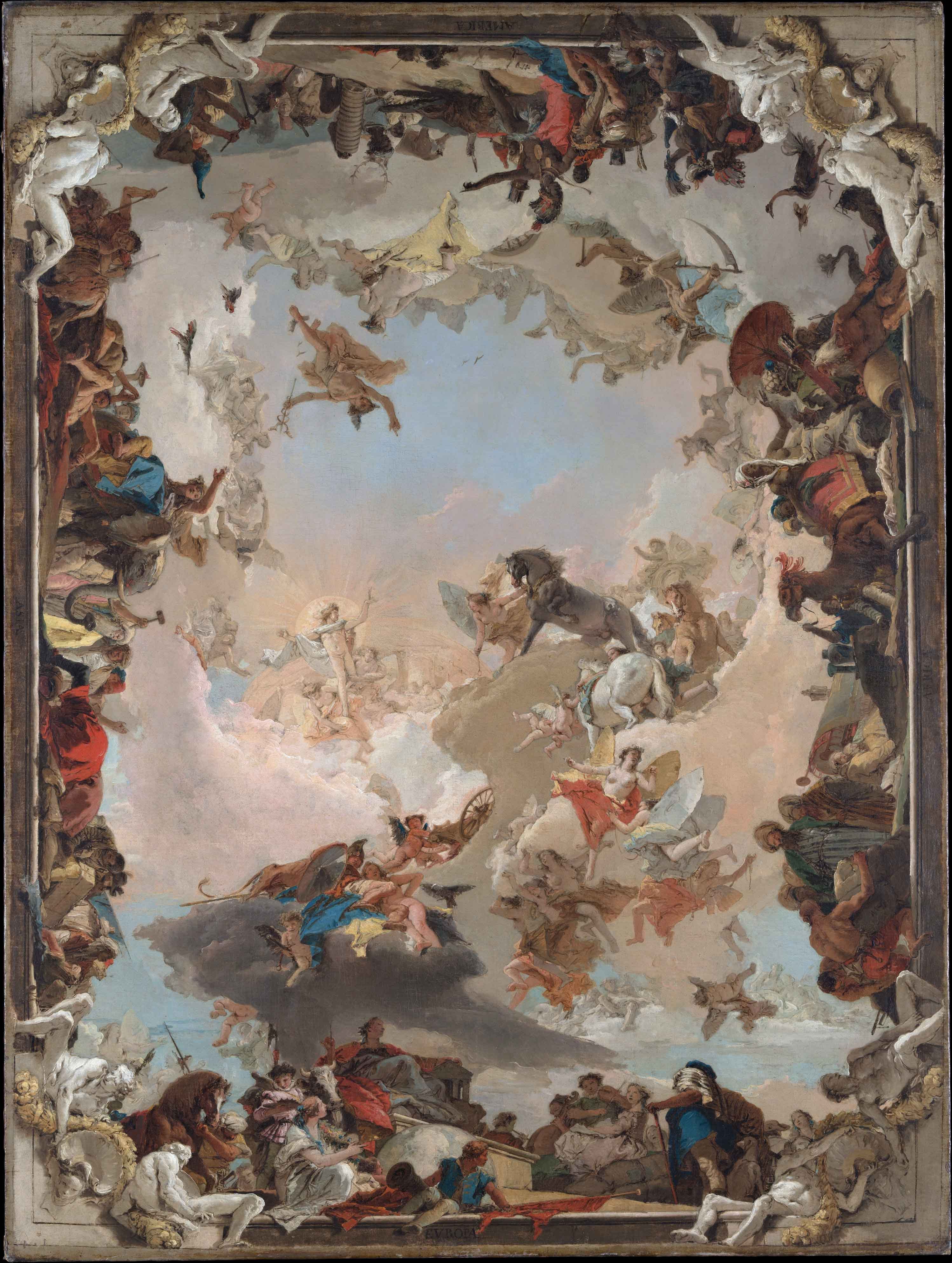
It is said that a man should dress for the job he wants, not the one he endures. It stands to reason, therefore, that a man who desires a better world should do what he can to will that world into being.
As we explored last week, Casanova stands as a model of how not to respond to a society in decline. Yet among his fellow Venetians there was another, living at the same time, and facing that same decline, who responded far more constructively. That man was Giovanni Battista Tiepolo.
Both Casanova and Tiepolo saw a Venice in decay. But while the former would surrender to and feed it, the latter would actually fight it, in the most graceful of ways. Raised in a world which had abandoned the ethereal for the emotional, and the grand for the personal, Tiepolo embraced the epic. In place of raw, dark and claustrophobic images of violence, he painted sweeping vaults that cast the viewer directly into the Heavens.
To Tiepolo, the world was a stage, and one in need of better scenery.
Here is what the greatest painter of the 18th century, and the author of Europe’s greatest splendor, can teach you about willing a better world into being: both in and outside the home…
But first — We’re going to Italy!
This May, we’re hosting two exciting retreats to Bergamo and Venice. To learn more and apply to join us, click the button below. Applications close February 14th:
Now, back to the article…
From the Shadow to the Sun
In 1697, little did the one year old Giovanni Battista Tiepolo know that his home country, the Republic of Venice, had just commenced her final century.
To others, however, the writing was beginning to shine upon the walls. The boy’s own father, Domenico Tiepolo, would likely have been one of them. As a merchant who worked in maritime commerce, he would have been all too aware of the collapse of Venetian political and economic power. Venice, who had once dominated Mediterranean trade, now struggled to pay even for the escort of her own ships.
Even the art seemed to reflect this gloominess. Venice had not produced a painter of international renown since the death of Tintoretto, a hundred years earlier. In the decades that followed, the violent realism of Caravaggio — himself a tortured soul — had come to dominate Italian canvases, or at least the perception of what ‘proper art’ was. Such chiaroscuro compositions were dark both in theme and execution, where scarcely lit figures emerged from an inky and depressing blackness. It was a world which Tiepolo would struggle against, and eventually overcome.
As happens with tragic frequency among the great men of history, Tiepolo was barely a year old when his father suddenly died. Unlike what happened to Caravaggio however, Tiepolo was raised lovingly by his widowed mother, Orsola, along with his five siblings. When the growing boy demonstrated a clear passion for the art of painting, he was not only permitted but encouraged to pursue it, and enrolled in the workshop of the city’s most prominent master, Gregorio Lazzarini.
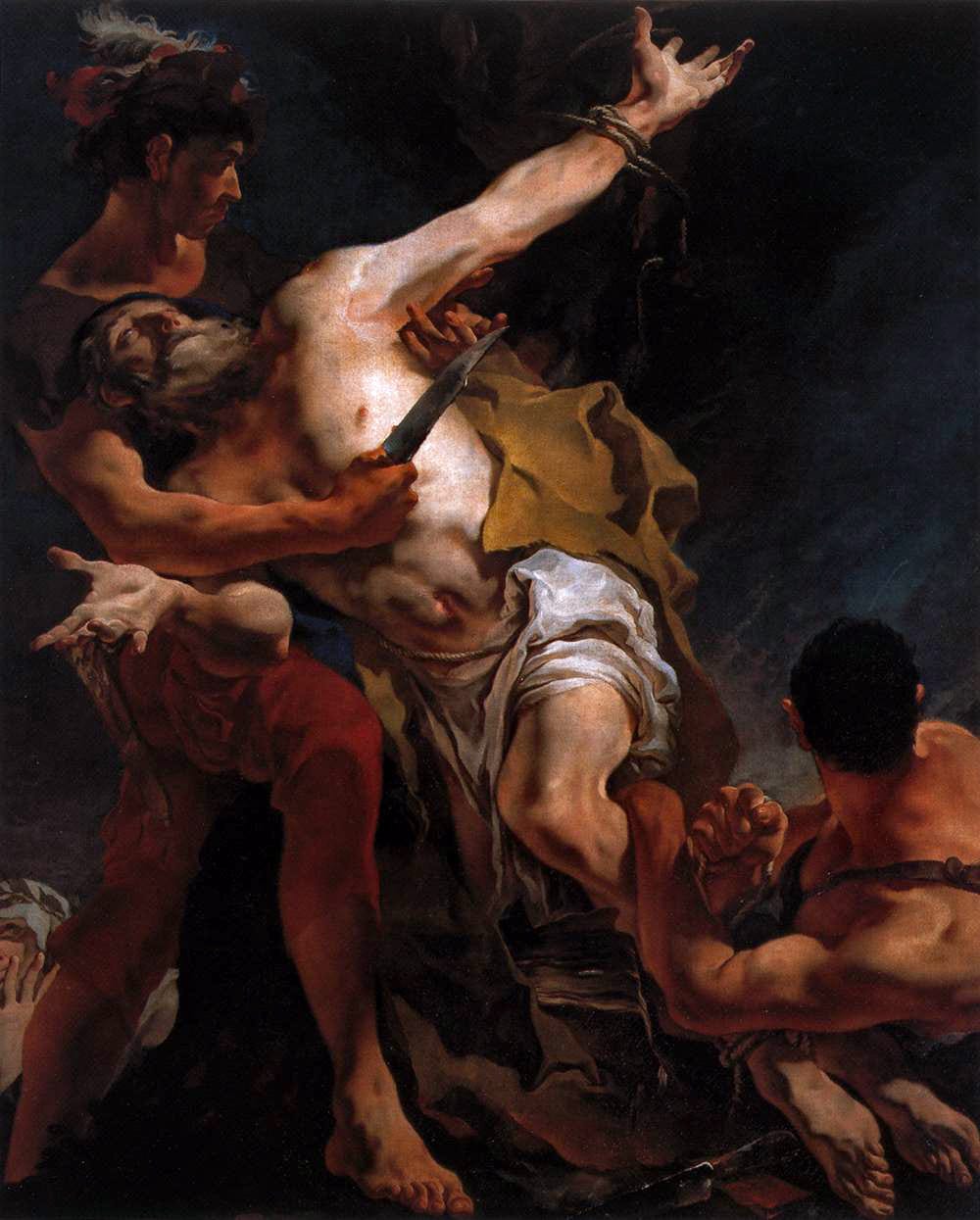
By all accounts, Lazzarini was a patient and attentive teacher, able to sharpen Tiepolo’s technical ability, and direct it to productive ends. That said, the early works of Tiepolo, following his admittance in 1717 to the Fraglia, or painter’s guild of Venice, were still rather conventional. The Martyrdom of Saint Bartholomew (pictured above), which he painted around 1722 for the Church of San Stae, is a typical example. High contrast, mildly claustrophobic and somewhat brutal, it fell well within the tradition of Caravaggio.
Fortunately for Tiepolo, however, his rapid mastering of the ‘standard of the day’ allowed him to build the confidence to leave it behind. As Vincenzo da Canal wrote in 1732, Gregorio Lazzarini’s star pupil:
“…Would however break from his diligent manner, and as a being of fire and spirit, embrace one both rapid and resolute”
Vincenzo da Canal, Vita di Gregorio Lazzarini, 1732
It would not take long to glimpse the rapid and resolute potential of a Tiepolo unchained.
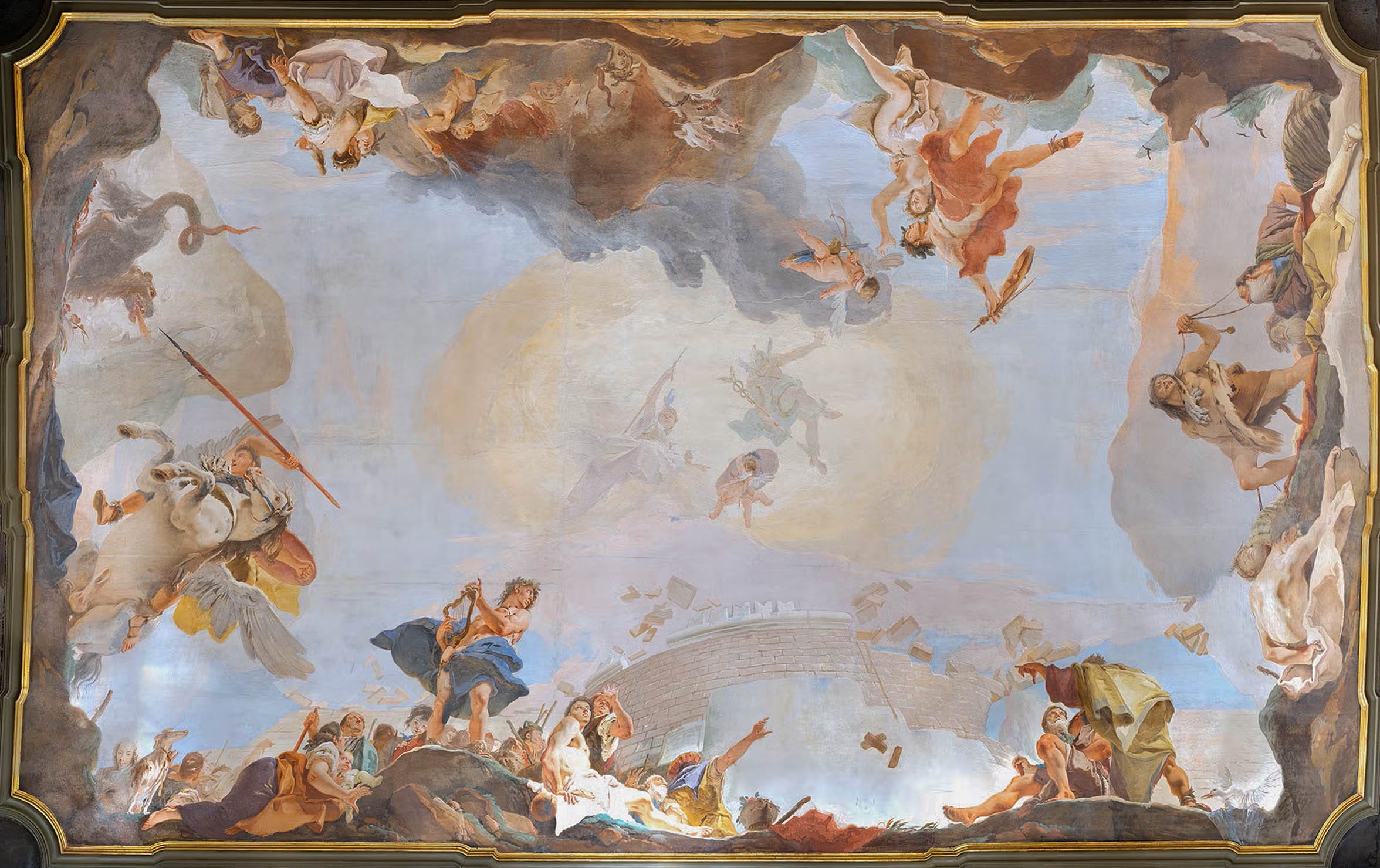
The art of fresco may be reckoned among the most gruelling skills any painter could hope to master. Painting a complex image onto canvas is one thing. Painting it onto wet plaster, however, is quite another. Now imagine decorating a ceiling in this manner, laying on your back, your face a foot from the surface, and able to see only a tiny portion of the full composition at any one time. This is the art that Giovanni Battista Tiepolo would both revive in dramatic style, and elevate to newfound grace.
Barely three years after completing the The Martyrdom of Saint Bartholomew, Tiepolo would unveil the first of a great many masterpieces indeed, on the ceiling of the Palazzo Sandi in Venice. The Force of Eloquence could scarcely be more different from the Martyrdom. Sprawling across the crown of the palace hall, it is as if the ceiling itself has been lifted away, and we are staring directly into the vault of Heaven. It is colourful, it is bright, it is ethereal, it is joyful.
Making the space to breathe, Tiepolo had found the perfect medium for his talent and his vision. Painting on ceilings, he required his viewers to crane their necks, and he would reward them for doing so with works that were both literally and metaphorically uplifting. As the title suggests, it is an allegorical celebration of the heights that eloquence can elevate a man to. A vision, quite simply, of a better world.
It was a vision that would capture the imagination of a generation. In a Venice accustomed to darkness, Tiepolo had lit a blazing torch…
Painting Away Decline
Frescoes, even those on ceilings, were of course far from new to Italian art. Michelangelo, after all, had frescoed the vault of the Sistine Chapel two hundred years earlier. Tiepolo, however, had revived the awe which ceiling fresco alone is able to muster.
Gone were the crowded compositions of the Baroque. In Tiepolo, the sky itself — the dome of Heaven — was the protagonist that humbled its figures.
What colourful figures they were, however. Reminiscent not of the musty taverns of 17th century Italy, but of something else that was swelling in popularity in the last century of old Europe — the Opera. In the words of Pietro Metastasio, the foremost librettist of the age:
“I imagine dreams and fables; and even on paper
While I adorn and draw fables and dreams,
In them, fool that I am, I take such a part,
That I weep and am disdainful of the ills I crafted...”
Pietro Metastasio, Sogni e favole io fingo; e pure in carte, 1733
So too was it with Giovanni Battista Tiepolo, who soon became a byword for dreams, and known as the man who could breathe life into dreams, and heaven into the home.
From the completion of The Force of Eloquence, Tiepolo would for the rest of his days never struggle for work, particularly after a commission from Dionisio Dolfin, Patriarch of Aquileia, to decorate the Patriarchate in Udine, would further propel him into the elite ranks of in demand artists. If his twenties had been devoted to finding his niche, his thirties would be his reward.
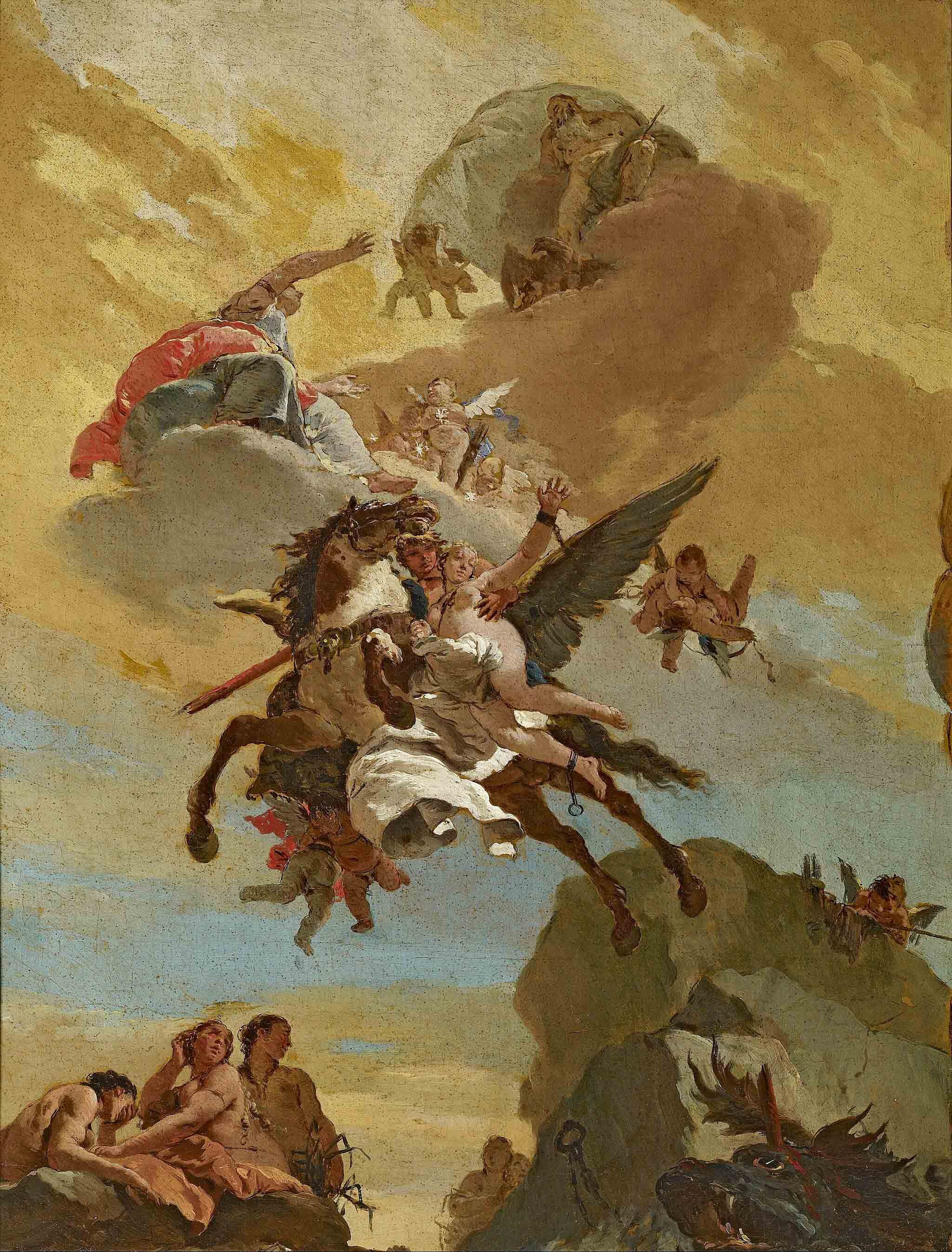
In 1730, he received his first major commission from abroad, in what was then the Austrian-ruled Duchy of Milan. As would become common in Tiepolo’s career, the occasion for his work was celebratory. Ahead of the aristocratic marriage between Filippo Archinto and Giulia Borromeo, he was charged with the beautification of Palazzo Archinto. The Palace, unfortunately, was bombed by the Allies of World War Two in 1943, though mercifully, photographs taken beforehand allow us to reconstruct Tiepolo’s lost frescoes, one of which, Perseus and Andromeda, we can see above. Here we see the beginnings of the trademark ‘Tiepolo Sky’, or pastel skies punctuated by dramatic swirls of gold and other vibrant colours.
His clients could not get enough of it, and by its completion, Tiepolo was famous. As Vincenzo da Canal observed at the time:
“He is extraordinarily prolific in his ingenuity; for this engravers and copyists seek to engrave his works, to obtain his inventions and read his bizarre thoughts; and already his drawings are so highly esteemed that books of them have been sent to the most distant countries.”
Vincenzo da Canal, Vita di Gregorio Lazzarini, 1732
In 1736 he was actually headhunted by King Frederick I of Sweden, who charged Count Carl Gustaf Tessin with inviting Tiepolo to decorate the Royal Palace of Stockholm. It was an honour no Venetian painter had known for generations, as demonstrated by Tessin describing him as a “follower of Veronese” (One of the most successful painters of the 16th century). Remarkably, however, Tiepolo declined, electing to focus on his own country.
His own country would indeed appreciate it. Indeed one rather gets the impression that Tiepolo had managed to unlock something in his compatriots. An awareness that something missing in Venice for a very long time was returning. As Anton Maria Zanetti, an influential Venetian art critic and dealer of the day wrote:
“[He is] Among the principal subjects that honour the Venetian tradition and are worthy of a truly talented painter, the vivacity of his spirit, combined with his intelligence, is truly remarkable. His unique merit is his ability to invent, and by inventing, to draw and refine at the same time a multitude of figures with novelty, multiplicity, and excellent array of tools and other things; combining this with a perfect understanding of clarity and of the most lucid beauty, which makes him worthy of distinction and of consideration among the highest ranks”
Anton Zanetti, Descrizione di tutte le pubbliche pittura della città di Venezia, 1733
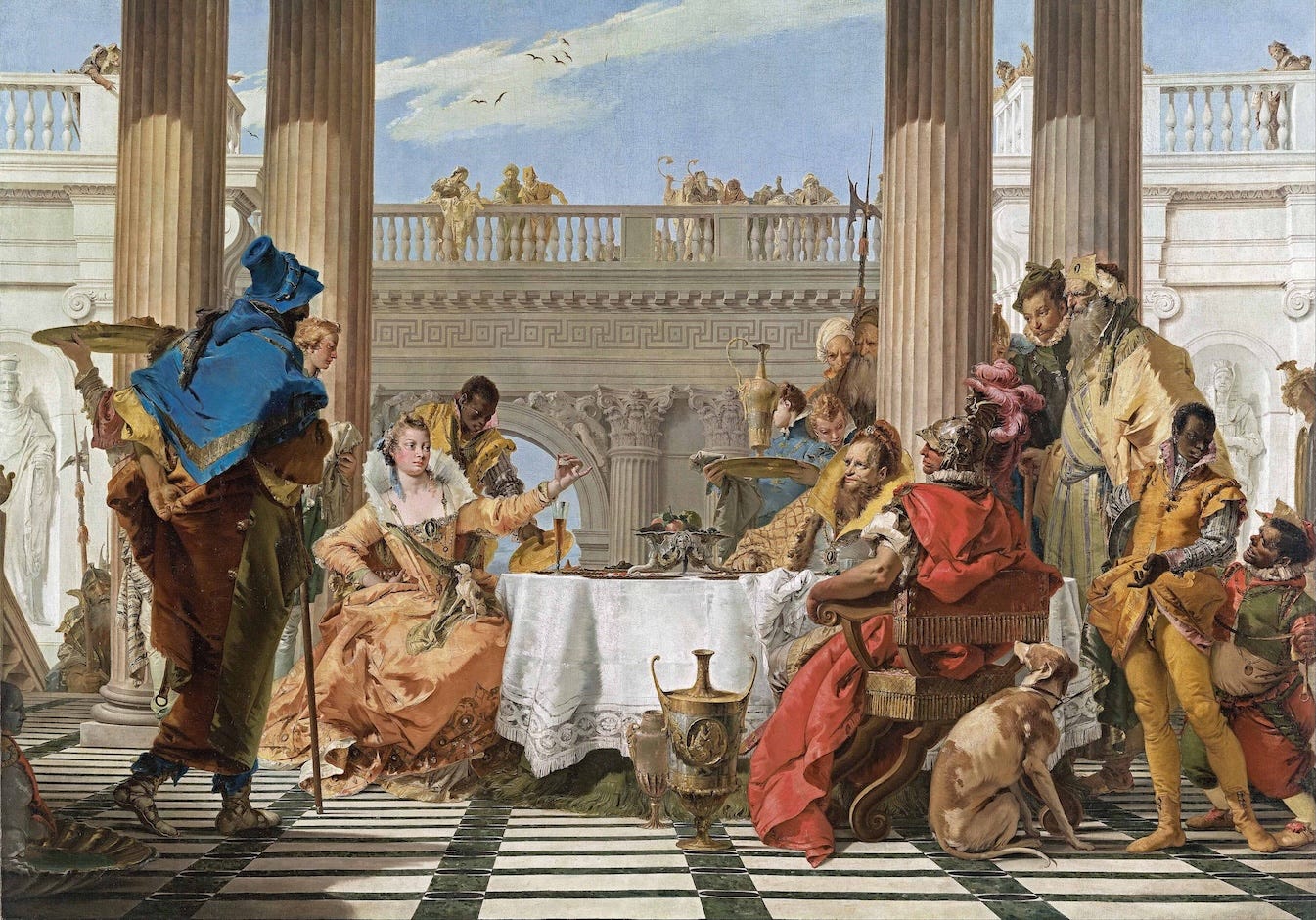
Amid his innumerable contributions to Venice, from the private palazzi of the nobility to the most splendid of her churches, his combination of vibrant light, operatic flamboyance and vivid colour conquered a city that had long prided itself on the search for beauty.
Tiepolo’s achievement, therefore, was already extraordinary. He had allowed his countrymen a vision of a brighter, better and more uplifting world. But Tiepolo’s greatness was, unlike with so many famed artists before and since, grounded in a simple yet wholesome reality.
His example indeed shows that you do not need to choose between family and greatness, and that one can indeed reinforce the other…
