
You Buy Books, But Do You Read Them?
Seneca on the proper use of books...

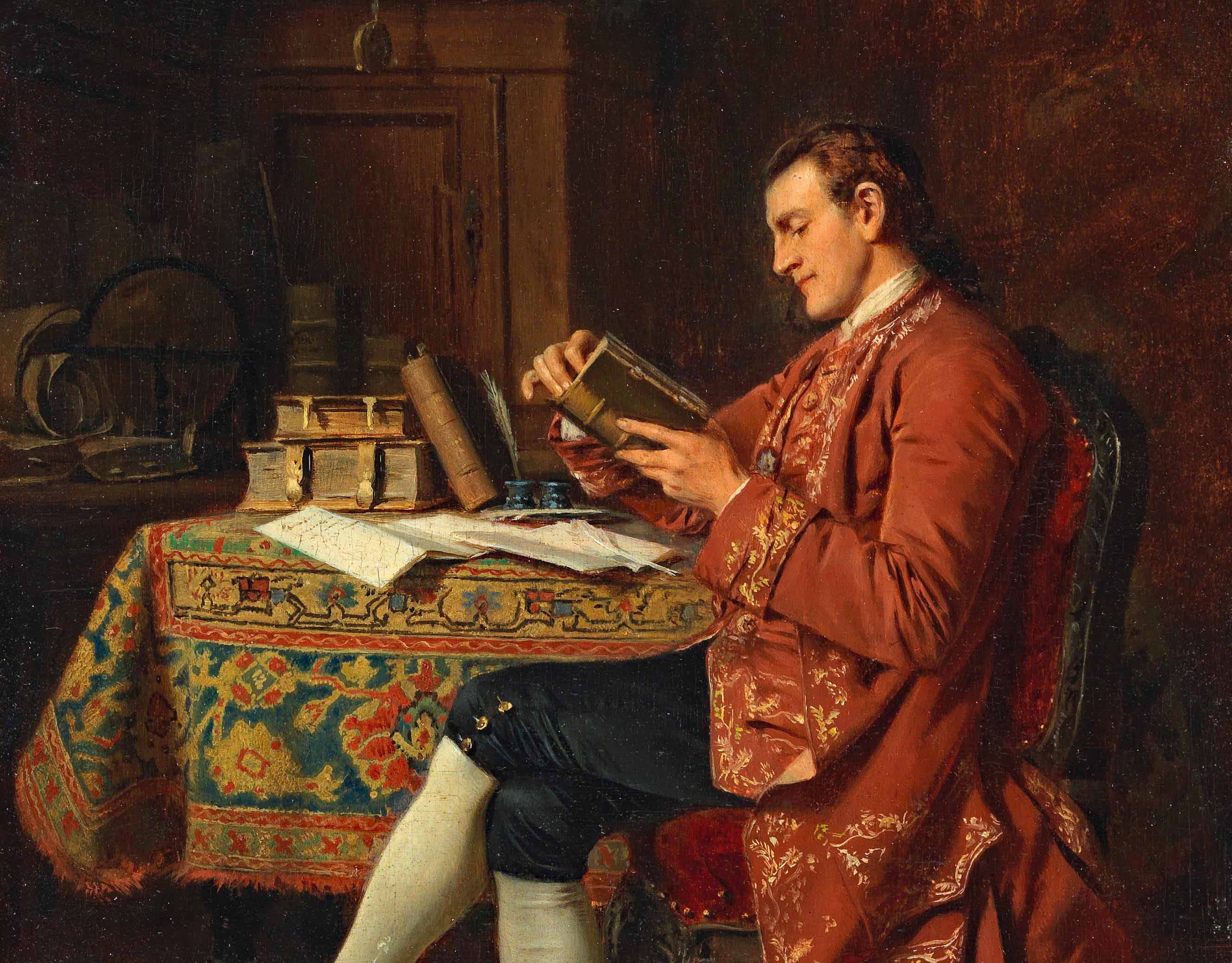
‘I need to start reading more’. How many of us have told ourselves this? Moreover, how many of us tell ourselves this on a regular basis, yet do so with an air of quiet resignation that that our wish is already doomed?
After all, almost every aspect of modern life conspires to ruin our attempts to read more. Whether it is through ever expanding ‘commitments’ which rob us of leisure time in the first place, or the continual presence of distractions when we do get it. It is all the more critical therefore to ensure that what time we can spend reading is used well — to ensure that we truly are reading, and not merely skimming.
But an unhealthy skimming culture concerns more than merely darting your eyes across the page. It concerns your entire relationship to knowledge.
One man who can help you cultivate a healthier relationship to books and knowledge is the philosopher and imperial advisor Seneca the Elder, whose many letters form a rich source of Roman practical wisdom. Two in particular — On Discursiveness in Reading, and On the Futility of Learning Maxims — contain critical advice for anyone eager to read more, or those who think they do not need to.
So if you are accumulating books but somehow never get round to reading them, or if you only ever find yourself ‘dipping in and out’ of books to hunt for references, here is how Seneca can help you to stop skimming, and start reading…
Avoid ‘Library Stuffing’
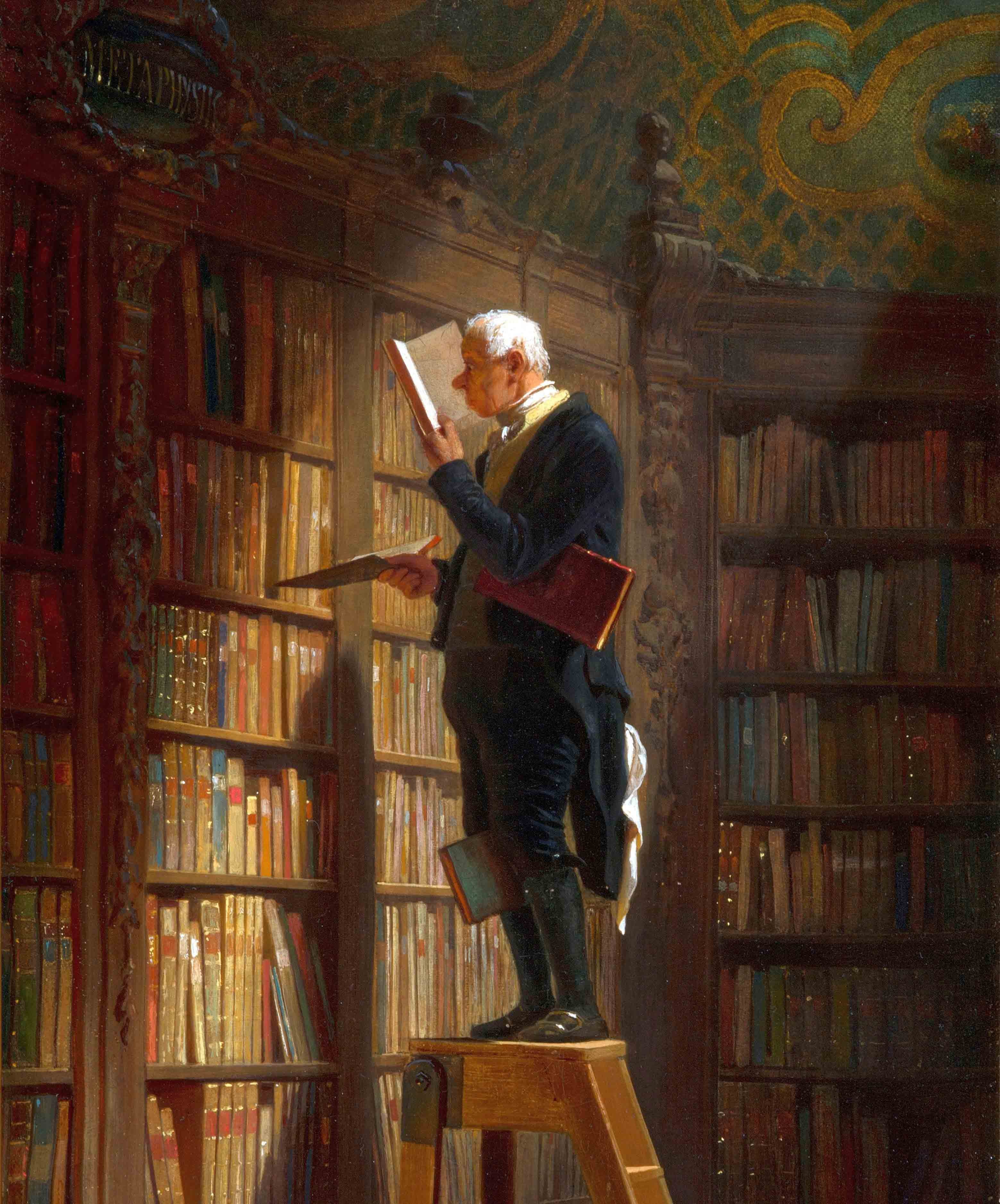
Nobody wants to be seen as ‘unintelligent’. Nobody wants to feel that the knowledge of the world is passing them by either, and thus the sensitive soul may understandably look around his house with horror if he sees empty bookshelves staring back at him, or no bookshelves at all.
After all when receiving guests, particularly for the first time, following the décor of our dwelling the first thing which generally catches their wandering eyes are the spines which jut out of our shelves. One can judge a man by what he reads, can he not?
Or can we? In truth, all this visual exercise reveals is what books the master of the house has purchased, inherited or received as a gift. It does not in fact tell us which ones he has read. Particularly when the mere possession of books can itself be a social statement or psychological crutch. The ignorant man may have barren shelves, but the wise man — or the man who thinks himself wise — may overcorrect by overburdening his shelves with rows upon rows of carefully catalogued tomes he purchased with pride yet never consults.
It is precisely this phenomenon of ‘library stuffing’ which Seneca warns his friend Lucilius against, in the first of his letters on literature:
“Accordingly, since you cannot read all the books which you may possess, it is enough to possess only as many books as you can read. “But,” you reply, “I wish to dive first into one book and then into another.” I tell you that it is the sign of an over-nice appetite to toy with many dishes; for when they are manifold and varied, they cloy but do not nourish”
Seneca, On Discursiveness in Reading, 3-4
Those of us who love books and love reading are amongst the worst offenders in this regard. We see a charming title, a beautifully illustrated cover, or even the author’s name, and we are sold. This in itself is of course among the most wholesome and harmless of vices, as exemplified by this charmingly relatable post which recently went viral:
This is not to ‘rebut’ Denise’s well-intentioned sentiment at all (particularly as she qualifies it with “immediately”). But to paraphrase Seneca, to terminate our burgeoning relationship with said books the moment we return home is quite like ordering a fine dish at a restaurant only to get up and leave once it arrives. We have not actually gained anything by this exercise, and the book might as well be a paperweight.
An adjacent phenomenon is to splash out on many books and indeed open them, but only to dive in briefly before we are distracted by the next. To the guilty party, Seneca has these words:
“Be careful, however, lest this reading of many authors and books of every sort may tend to make you discursive and unsteady. You must linger among a limited number of master thinkers, and digest their works, if you would derive ideas which shall win firm hold in your mind. Everywhere means nowhere. When a person spends all his time in foreign travel, he ends by having many acquaintances, but no friends. And the same thing must hold true of men who seek intimate acquaintance with no single author, but visit them all in a hasty and hurried manner. Food does no good and is not assimilated into the body if it leaves the stomach as soon as it is eaten; nothing hinders a cure so much as frequent change of medicine; no wound will heal when one salve is tried after another; plant which is often moved can never grow strong. There is nothing so efficacious that it can be helpful while it is being shifted about. And in reading of my books is distraction.”
Seneca, On Discursiveness in Reading, 2-3
“Everywhere means nowhere”. Whether it is because our attention span is simply not up to dwelling upon a single book, or a sense of guilt at our runaway spending which has convinced us that we must constantly draw upon as many corners of our shelves as possible, the result is the same. We order a majestic dish that was prepared with love and devised by the deepest roots of tradition, only to wolf it down and immediately cleanse the palate with the next.
We must not therefore, fall into the subconscious trap which convinces us that simply possessing a book is in some way a shortcut to its wisdom. You may have bought a house with a garden, but unless you take up the trowel and get your fingers dirty, weeds will sprout where you dreamed of flowers.
Here we return to that skimming culture, and arguably its most toxic consequence…
Beware ‘Quote Culture’
In a similar way to the manner in which we arrange our bookshelves to deceive ourselves or our visitors, we are terribly prone to using quotations to artificially ‘prop up’ the image of our wisdom.
In Seneca’s second letter on the subject, he advises Lucilius to beware the phenomenon that is no less common in our own times, particularly among highly educated readers — to treat books as a mine for quotations:
“There is unevenness, you know, when some objects rise conspicuous above others. A single tree is not remarkable if the whole forest rises to the same height. Poetry is crammed with utterances of this sort, and so is history”
Seneca, On the Futility of Learning Maxims, 1
Arguably this is even more pronounced a problem today, when ‘one-liners’ and ‘gotchas’ can elevate or destroy a man in minutes. The problem is when this spills over into our reading, and we find ourselves racing impatiently towards lines we were already looking for. We are, in essence, trying to take a shortcut to wisdom that we have not ‘earned’ by accompanying the author in their argument. We are applying industrial method to art.
An especially serious manifestation of ‘Quote Culture’, however, is when misquotations supplant the original words in the popular imagination. Generally this happens when generations of people who had heard the phrase but are unfamiliar with the source material have, out of a desire to socially impress, awkwardly shoehorned it into incorrect contexts. Even worse is when the actual words themselves have slightly changed yet totally changed the meaning.
To give but one example, you have almost certainly heard the following expression at least once:
“Power corrupts. Absolute power corrupts absolutely”
It is commonly used as a ‘one-hit wonder’ line to close any conversation about power dynamics, especially in politics. There is one slight problem however.
Let us consider the actual source of this quotation — an 1887 letter by Lord Acton to Archbishop Mandell Creighton:
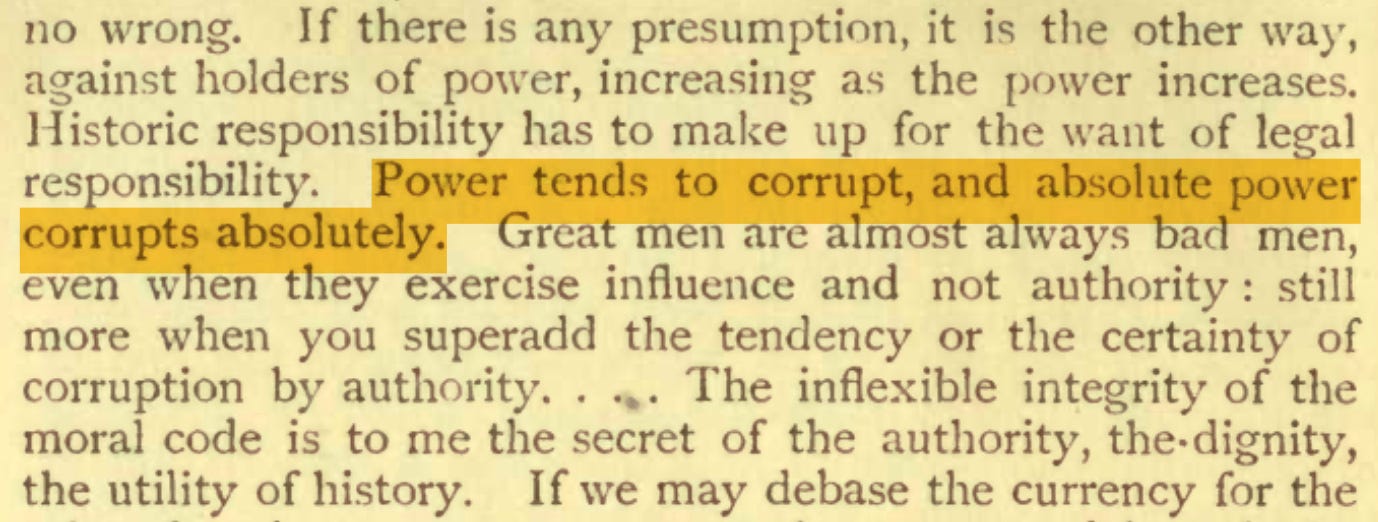
At first glance, it may not seem that much is different. But there is a critical difference which separates Acton’s line from the cliché. We say that power corrupts. To Acton, however, power tended to corrupt. A conditional, therefore, has been twisted into an absolute. Corruption to Acton was something a man should be wary of, but could avoid through the cultivation of good character. Yet those who misquote him — consciously or not — imply that men are all guaranteed to be corrupted should they aspire to power. A healthy warning has transformed into cynical nihilism.
A proper digestion of Acton would suggest that good men should seek out power to keep the corruptible out. The cliché however would have all men steer clear of authority. So why do we treat the cliché as wisdom worthy of note? Since Acton did not say it, all that is left is ‘Because it’s a famous saying, so it must be correct’. In other words, the ‘appeal to authority’ fallacy. Consider, if you will, just how many times this misquotation has been deployed in modern discourse, and how easily therefore wisdom can be falsified when outsourced to others.
The wise Seneca therefore tells Lucilius that while he can recommend the works of other thinkers and writers, he will not simply supply him with a list of quotations:
“Hence we have no ‘show-window goods’, nor do we deceive the purchaser in such a way that, if he enters our shop, he will find nothing except that which is displayed in the window. We allow the purchasers themselves to get their samples from anywhere they please”
Seneca, On the Futility of Learning Maxims, 3
Just as merely possessing books does not mean we can call ourselves knowledgeable of their contents, we cannot deceive ourselves into thinking that the ability to recite a quotation means we actually understand the wisdom behind it. As with Acton, in some cases skimming for quotations can be worse than not reading at all.
So if accumulating masses of books and skimming them is not the way, what is? You might fear at this point that the ‘right way’ is just going to be more expensive and time-consuming.
Fear not however, for Seneca’s advice will save you time and money, and will ensure your books stop being one-off expenses and start bringing you a lasting return on investment…
