
Who Are Your Real Friends?
Plutarch on whether you have friends, or flatterers...


Do you have friends, or do you have flatterers?
That person who complimented you — do they truly wish you well, or do they want something from you?
It is a reality that confronts us on so regular a basis that discussion of it might today seem more suited to gossip than reasoned reflection. But to our ancestors, it was a deadly serious matter.
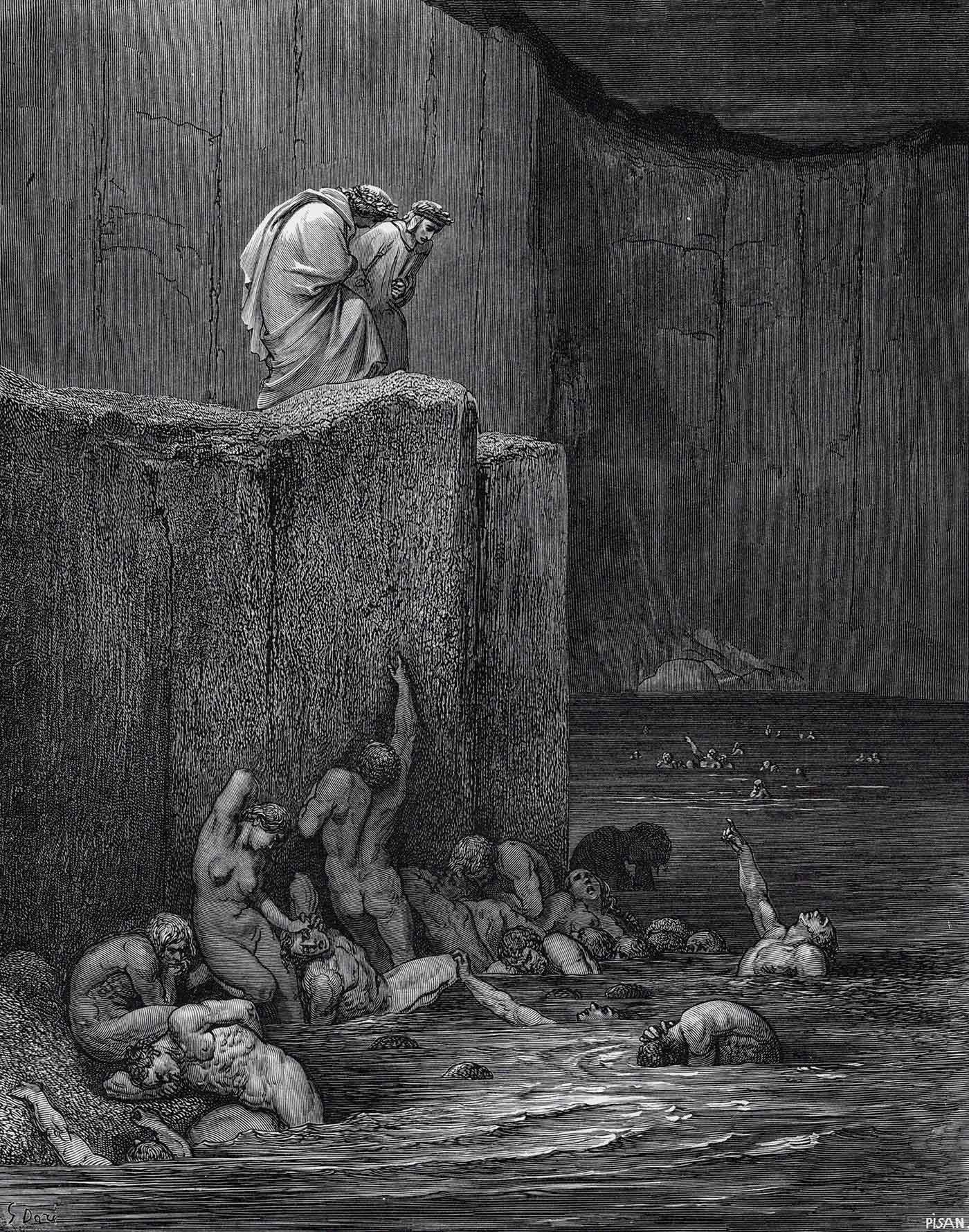
Not for nothing, after all, did Dante Alighieri in his Divine Comedy consign flatterers to the penultimate circle of Hell, further into the Abyss even than those who commit murder. The condemnation of flattery was likewise a common theme in Classical thought, along with discussion of what friendship truly is.
One of the most influential writers and philosophers of the Greco-Roman world, Plutarch of Chaeronea, indeed dedicated an entire essay of his Moralia to the subject.
Today therefore, we explore how the aptly named How One May Discern a Flatterer From A Friend can help you identify destructive friendships and build more wholesome ones…
The Danger of Flattery
Flattery, noun - The action or practice of flattering; false or insincere praise; adulation; cajolery, blandishment.
Taking into account the current Oxford English Dictionary definition of the term, it may seem a shrill overreaction to consider Flattery a sin worse than Greed, Gluttony, Lust and Wrath, as Dante did. Indeed it might be, if we considered purely the act of flattery, and ignored the consequence.
Plutarch, however, emphasises repeatedly in his essay what that consequence is. Among the most succinct of these is as follows:
“Those who injure the character by their praise, aye, and by their flattery undermine the morals, act like those slaves who do not steal from the bin, but from the seed corn. For they pervert the disposition, which is the seed of actions, and the character, which is the principle and fountain of life, by attaching to vice names that belong properly only to virtue”
Plutarch, How One May Discern a Flatterer From A Friend, XII
As per the metaphor he presents, Flattery therefore is fundamentally worse than Theft. For if a scoundrel seizes your wallet and makes off with it, it is certainly heinous, but the consequence will likely be inconvenience for you in the short term only, while making you more cautious in the future. Crucially, there is virtually no possibility that you will view the act as anything less than what it is — evil.
But a flatterer’s crime has many consequences. A person who seeks to curry your favour only ever does so because they want something from you, whether it be a tangible reward or intangible benefit. If they succeed in their efforts, they have obtained something from you by dishonest means, but worse, they have also corrupted you in the process.
A man robbed by violence many times is likely to be fortified by his experiences. A man who succumbs to flattery many times is caught in a spiral that will drag his entire character down along with his moral defences. Thus the flatterer succeeds in:
“Implanting in everybody’s mind self-deceit and ignorance of his own good or bad qualities, thus making his good points defective and imperfect, and his bad points altogether incorrigible”
Plutarch, How One May Discern a Flatterer From A Friend, I
The long term consequences of this can be devastating to individuals, to families, to businesses and indeed nations. After all, the flatterer by nature targets those who wield influence. For Plutarch, the fallout of this was demonstrably corrosive to societies, citing the words of the great historian Thucydides, who decried the power of unchecked Flattery to rebrand immorality as admirable:
“Words had to change their ordinary meaning and to take that which was now given them. Reckless audacity came to be considered the courage of a loyal ally; prudent hesitation, specious cowardice; moderation was held to be a cloak for unmanliness; ability to see all sides of a question, inaptness to act on any. Frantic violence became the attribute of manliness; cautious plotting, a justifiable means of self-defence. The advocate of extreme measures was always trustworthy; his opponent a man to be suspected.”
Thucydides, The Peloponnesian War, III.82
Just because Flattery occurs everyday does not, therefore, mean it is trivial. On the contrary, that it hides in plain sight is an indication of its severity and its infectious nature.
So, how can we identify those who are merely using us under the pretence of friendship?
How to Identify a Flatterer
Part of the reason why Plutarch proved so influential over the course of the centuries is that, unlike in the ‘higher’ philosophy of men like Plato and Aristotle, his essays are concise, easy to translate and easy to read, being digestible in a single sitting.
Indeed in How One May Discern a Flatterer From A Friend, we can identify a simple set of signs to look out for:
1 - Inconsistent Admiration
Since the flatterer operates by feigning sympathy, and seeks to convince others that he is ‘just like them’, as Plutarch points out, he cannot have fixed principles:
“We must first then look at the even tenor and consistency of his principles, if he always delights in the same things, and always praises the same things, and directs and governs his life after one pattern, as becomes the noble lover of consistent friendship and familiarity. Such a person is a friend. But the flatterer having no fixed character of his own, and not seeking to lead the life suitable for him, but shaping and modelling himself after another’s pattern, is neither simple nor uniform, but complex and unstable, assuming different appearances, like water poured from vessel to vessel, ever in a state of flux and accommodating himself entirely to the fashion of those who entertain him.”
Plutarch, How One May Discern a Flatterer From A Friend, VII
He is at all times calculating which position it is you hold, so that he can pretend he holds it too. This calculation can only be made on the basis of what you do and say, or what others have said about you.
If you suspect that someone is seeking to ingratiate themselves with you, and the stakes are sufficiently serious, Plutarch advises an easy test. At some point down the line, pretend to change your conviction on something. It could be anything, but the more it stands in contrast to something you actually believe, and the more controversial, the better. Observing the reaction of the other person will flush out many amateur flatterers, who will be tempted to mimic your conversion and forced to improvise an explanation when pushed.
2 - The Mirror of Temper
“The true friend does not imitate you in everything, nor is he too keen to praise, but praises only what is excellent”
Plutarch, How One May Discern a Flatterer From A Friend, IX
The most naked act of Flattery lies in praising your good deeds. But Flattery, being an offshoot of Fraud, rarely stops there. A flatterer determined to conquer your empathy will aim even lower, and minimise your flaws by pretending he possesses them too.
“For seeing that their friends are unfortunate in marriage, or suspicious about the behaviour of their sons or relations, they do not spare themselves, but make quite a Jeremiad about their own sons, or wife, or kinsfolk, or relations, proclaiming loudly their own family secrets”
Plutarch, How One May Discern a Flatterer From A Friend, IX
‘Oh, I do that too’ he may retort, or else ‘Don’t worry, people do that all the time’. A true friend will praise your successes, but confront your wrongdoing. A flatterer will almost never do the latter, and thus out of sycophancy lead you further astray. Beware the man who mirrors the worst of you.
3 - The Constant Second Fiddle

The tactical objective of the flatterer is to force your ego to outflank your reason:
“Whereas among real friends there is no rivalry or jealousy of one another, but they are satisfied and contented alike whether they are equal or one of them is superior. But the flatterer, ever remembering that he is to play second fiddle, makes his copy always fall a little short of the original, for he admits that he is everywhere outstripped and left behind, except in vice”
Plutarch, How One May Discern a Flatterer From A Friend, X
While he will pretend to share your virtues and vices, or else hobbies and peeves, the illusion tempts your ego by casting him as the apprentice to your master. No matter how great his success may truly be, he will always be ready with some contrivance to dull it in comparison to your own.
Likewise, if you lament of failure, he will always respond by telling you that his own is worse:
“If his friend is superstitious, he says he is a fanatic; if his friend is in love, he says he is madly in love; if his friend laughs, he will say, ‘You laughed a little unseasonably, but I almost died of laughter’”
Plutarch, How One May Discern a Flatterer From A Friend, X
In the presentation of the flatterer, you have always “reached a height he cannot soar to”. One must always question the value of a friendship with one who apparently has nothing to teach you.
4 - Praise for Imagined Virtue
The clumsy flatterer will praise you for what you are, yet also for what you are not. This is particularly the case when you have achieved public prominence, and people are intimidated to present any serious challenge or genuine opposition to you.
The flatterer will ‘bend the rules’ so that he can assign you greater talent than you actually possess. The sons of the successful must be especially careful to watch out for this, lest they end up having:
“learnt nothing really well and properly except how to ride, for their master praised and flattered them in their studies, and the person who taught them wrestling always let them throw him, whereas the horse, not knowing or caring whether his rider were a private person or ruler, rich or poor, soon threw him over his head if he could not ride well.”
Plutarch, How One May Discern a Flatterer From A Friend, XVI
Since this form of Flattery almost always occurs when others are listening, observing the reactions of others to it can help you quickly identify how prominent Flatterers are in your immediate circle.
5 - Selective Outrage
“Next he pretends to know nothing of real and great crimes, but he is a terrible fellow to inveigh against trifling and external shortcomings, and to fasten on them with intensity and vehemence, as if he sees any pot or pipkin out of its place, or anyone badly housed, or neglecting his beard or attire, or not adequately attending to a horse or dog.”
Plutarch, How One May Discern a Flatterer From A Friend, XVII
The flatterer, accustomed to the practice of Fraud, is defined by inconsistency of conduct and of standards.
His perceived need to ‘keep up appearances’ opens many cracks between his public and private life, and severely distorts his behaviour across contexts. A flatterer will fawn over his dinner guest, yet disdain the waiter. Disproportionate wrath, too, will be levelled at anybody who reveals, or threatens to reveal, the falsity of his persona.
Likewise, one often finds the flatterer to be outspoken on trivial things, yet silent on the serious. Plutarch here cites the example of Ptolemy VIII, the fearsome ruler of Egypt. For when he wished to be intellectual, his sycophantic advisors would waste time late into the night mirroring it, disputing mere grammar or vocabulary, but none objected in the slightest to his cruelty during the day.
Armed with Plutarch’s wisdom therefore, we have a good chance of unmasking the malign influences in our life. But with our flatterers identified, how on the other hand can we know who our true friends are?
Fortunately, Plutarch follows up with timeless advice on what real friendships should be doing for you. Perhaps surprisingly, he begins by arguing that true friends should bring you pain as much as pleasure…
