
How Marcus Aurelius Faced the Day
How Rome's most virtuous emperor dealt with stress and difficult people...

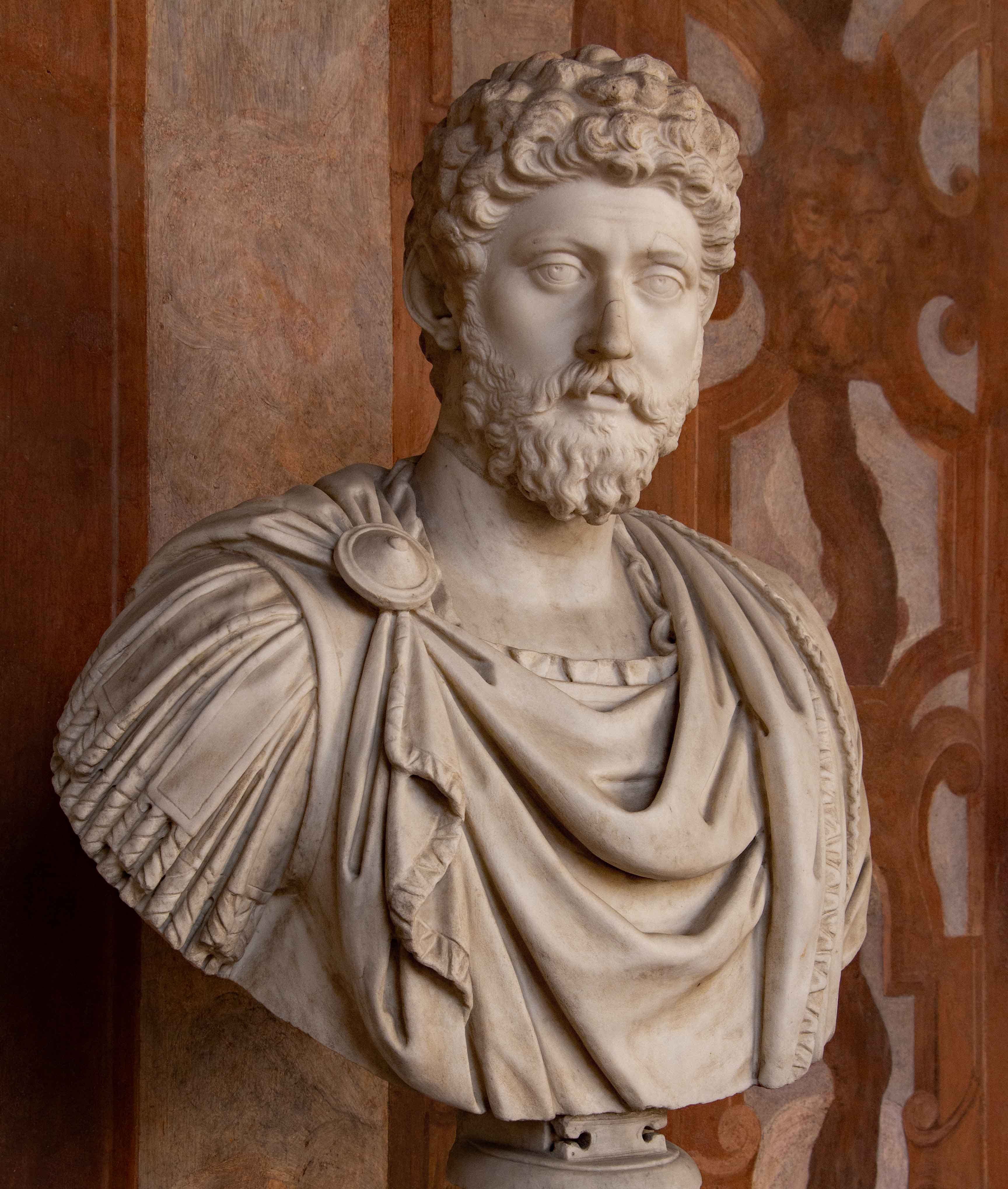
Such is the prestige of the title of Caesar that it is easy to forget that the emperors of Rome were men of flesh and blood, who rose in the morning and retired, exhausted, to bed in the evening like anyone else.
It is easy, too, to assume that the Roman Empire was governed in the manner post-Enlightenment intellectuals and Hollywood directors would like you to believe it was — an absolute autocracy where the Emperor’s word was as good as divine mandate.
In reality, imperial rule was a habitual struggle to balance multiple competing factions, from senatorial oligarchs to ambitious generals, against the duty to both the Roman people and the Roman gods. Any emperor who dared to subvert these checks upon his duty swiftly met with conspiracy and demise.
As a result, the most successful of the Caesars were those able to get things done while maintaining good relations with each of these factions. That of course meant dealing with constant pressure, powerful interests and regular interpersonal conflict. It is perhaps no surprise, therefore, that the only surviving account that any Roman Emperor left of his own personal philosophy, the Meditations of Marcus Aurelius, has much to say on how to handle a stressful life.
So, here is what the most beloved of all Roman Emperors can teach you about preparing for the day, dealing with conflict and recovering afterwards…
Choosing Your Battles

“Remember to put yourself in mind every morning, that before night it will be your luck to meet with some busy-body, with some ungrateful, abusive fellow, with some knavish, envious, or unsociable churl or other”
Marcus Aurelius, Meditations, II.1
After dedicating the first book of the Meditations to naming all those he felt gratitude towards, the opening of the second is as memorable as it is cutting.
As the most famous incarnation of the ancient ideal of the ‘philosopher king’, there is something of a tendency to view Marcus Aurelius as a man entirely detached from the world. In a sense he was, but he was not naïve. A philosopher he was, but a Stoic philosopher, and the essence of Stoicism lies in the belief that inner peace and tranquility can only be achieved by recognising and accepting what is in your power to control, and what is not.
A cynical reading of this would be ‘no matter what you do, there will be bad people’. A more patient reading of the Meditations, however, reveals that this is not exactly what the Emperor intended:
“Now all this perverseness in them proceeds from their ignorance of good and evil; and since it has fallen to my share to understand the natural beauty of a good action, and the deformity of an ill one — since I am satisfied the person disobliging is of kin to me, and though we are not just of the same flesh and blood, yet our minds are nearly related, being both extracted from the Deity”
Marcus Aurelius, Meditations, II.1
The Stoic mind, therefore, recognises that people can be unpleasant and hostile, but also that even in such moments they are still people. When someone is rude to us, our instinct might be to insult and dehumanise them. ‘What an awful person’, we might think, dismissing them forever. But are they? Are they really?
An instinctive reaction to rudeness is revulsion and anger, and to succumb to it is flawed for two reasons:
“Are you angry at a rank smell or an ill-scented breath? What good will this anger do you? But you will say, the man has reason, and can, if he takes pains, discover wherein he offends. I wish you joy of your discovery. Well, if you think mankind so full of reason, pray make use of your own. Argue the case with the faulty person, and show him his error. If your advice prevails, he is what you would have him; and then there is no need of being angry”
Marcus Aurelius, Meditations, V.28
As humans, we are — or should be — in a perpetual state of growth, while also being continuously subjected to influences both benign and wicked. That man who shouted on the phone, or who barged past you onto the bus — is he always like this, or did your paths happen to cross at a moment when he was under particularly acute stress? Or, more importantly, imagine all those moments when you yourself lost control in the presence of bystanders. Those strangers may well have dismissed you as an ‘awful person’. Now consider how many times that has happened throughout your life, and thus how many people in the world have written you off as an ‘awful person’. Is that representative, or just?
Secondly, overreaction closes off the possibility of transforming destructive anger into wholesome learning. As Marcus informs us elsewhere, “the obstacle is the way” (V.20). If we are all of the same kin, all children of Heaven, then conflict is an opportunity either for your or the other party’s growth. Take it, otherwise the interaction remains a sore forever. Should argument erupt over how something should be done, one or both parties should emerge enlightened from the dispute, and your being prepared to be that party is essential to being a better person.
“If any one can convince me of an error, I shall be very glad to change my opinion, for truth is my business, and nobody was ever yet hurt by it. No; he that continues in ignorance and mistake, it is he that receives the mischief”
Marcus Aurelius, Meditations, VI.21
Winning an argument is a temporary victory. Remaining in error, however, is a permanent defeat.
In the crudest possible sense, every negative interaction is merely a battle. Winning a battle, however, is meaningless without a wider strategy for the war…
Maintaining Perspective
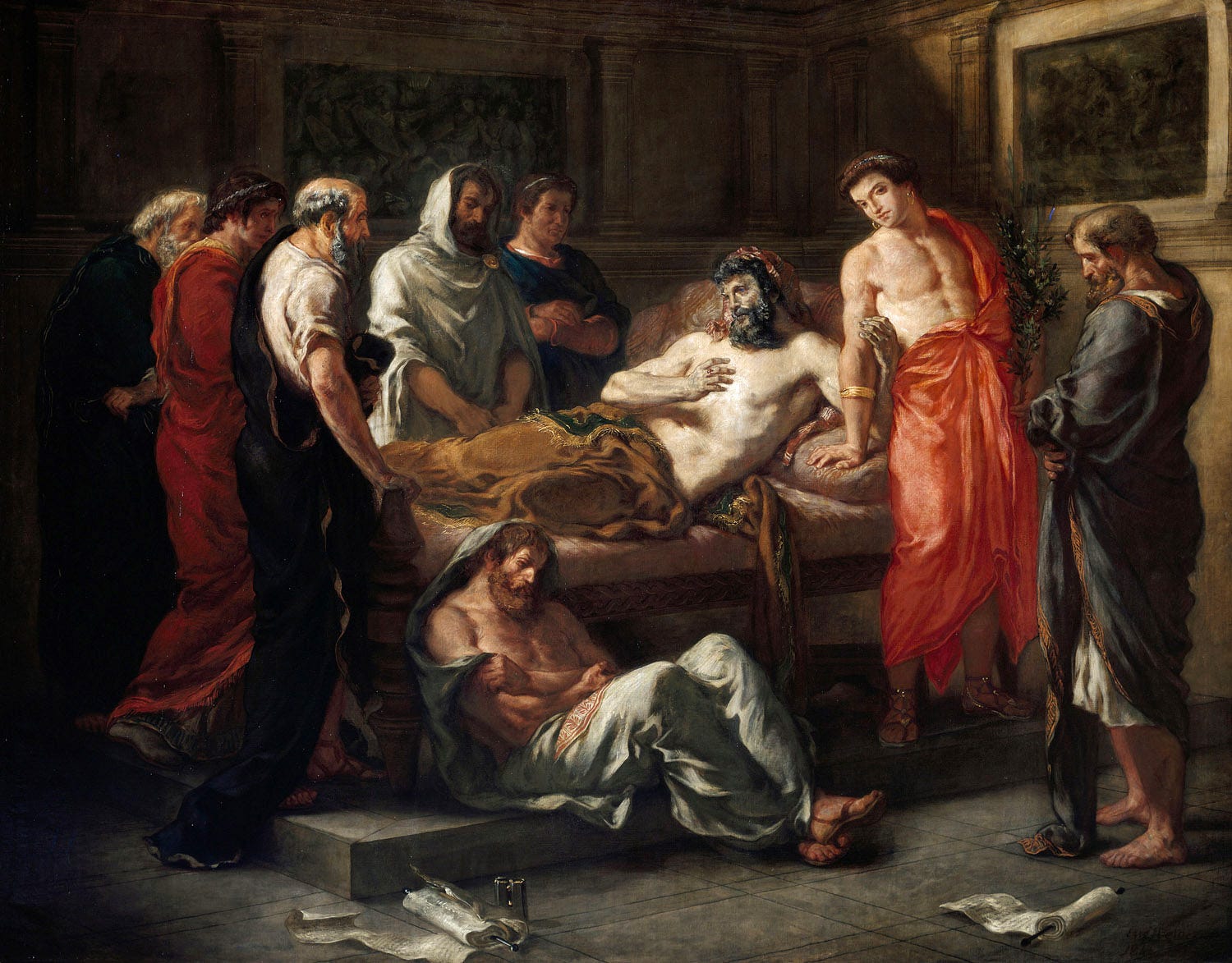
“But, it may be, the distribution of the world does not please you. Recall the alternative, and argue thus: either Providence or atoms rule the universe.”
Marcus Aurelius, Meditations, IV.3
No matter how benevolent our intent or sincere our beliefs, not all our interactions with others will end positively. Perhaps bad faith, or else unfortunate circumstance made dialogue impossible. Depending on the situation and the identity and role of the other person, it may even have created more problems.
Such moments are prone to leaving us to wallow in negative emotion that can easily spill over into the rest of the day or week. The surest way to guard against this, as Marcus reminds us, is to maintain a sense of perspective. Whether you believe that “Providence” or “atoms” govern the universe is irrelevant. In the same way that one cannot judge the soul of a man on the basis of his worst moments alone, we cannot allow our lives to be hijacked by fleeting moments of failure. As men, we have a terrible propensity for allowing ourselves to be wounded, and compounding the blow by refusing to staunch the bleeding:
“Consider, likewise, how many men have embroiled themselves, and spent their days in disputes, suspicion, and animosities; and now they are dead, and burnt to ashes. Be quiet, then, and disturb yourself no more”
Marcus Aurelius, Meditations, IV.3
If you adhere to “atoms”, none of it matters at all. If you hold to “Providence”, it also does not matter, because every man is on a journey, and as long as you draw breath, that journey has not ended.
It is here that the Emperor issues us with a call, to himself as much as to us, to duty and to our higher purpose:
“Take care always to remember that you are a man and a Roman; and let every action be done with perfect and unaffected gravity, humanity, freedom, and justice. And be sure you entertain no fancies, which may give check to these qualities. This is possible, if you will but perform every action as though it were your last; if your appetites and passions do not cross upon your reason; if you keep clear of rashness, and have nothing of insincerity and self-love to infect you, and do not complain of your destiny. You see what a few points a man has to gain in order to attain to a godlike way of living for he that comes thus far, performs all which the immortal powers will require of him.”
Marcus Aurelius, Meditations, II.5
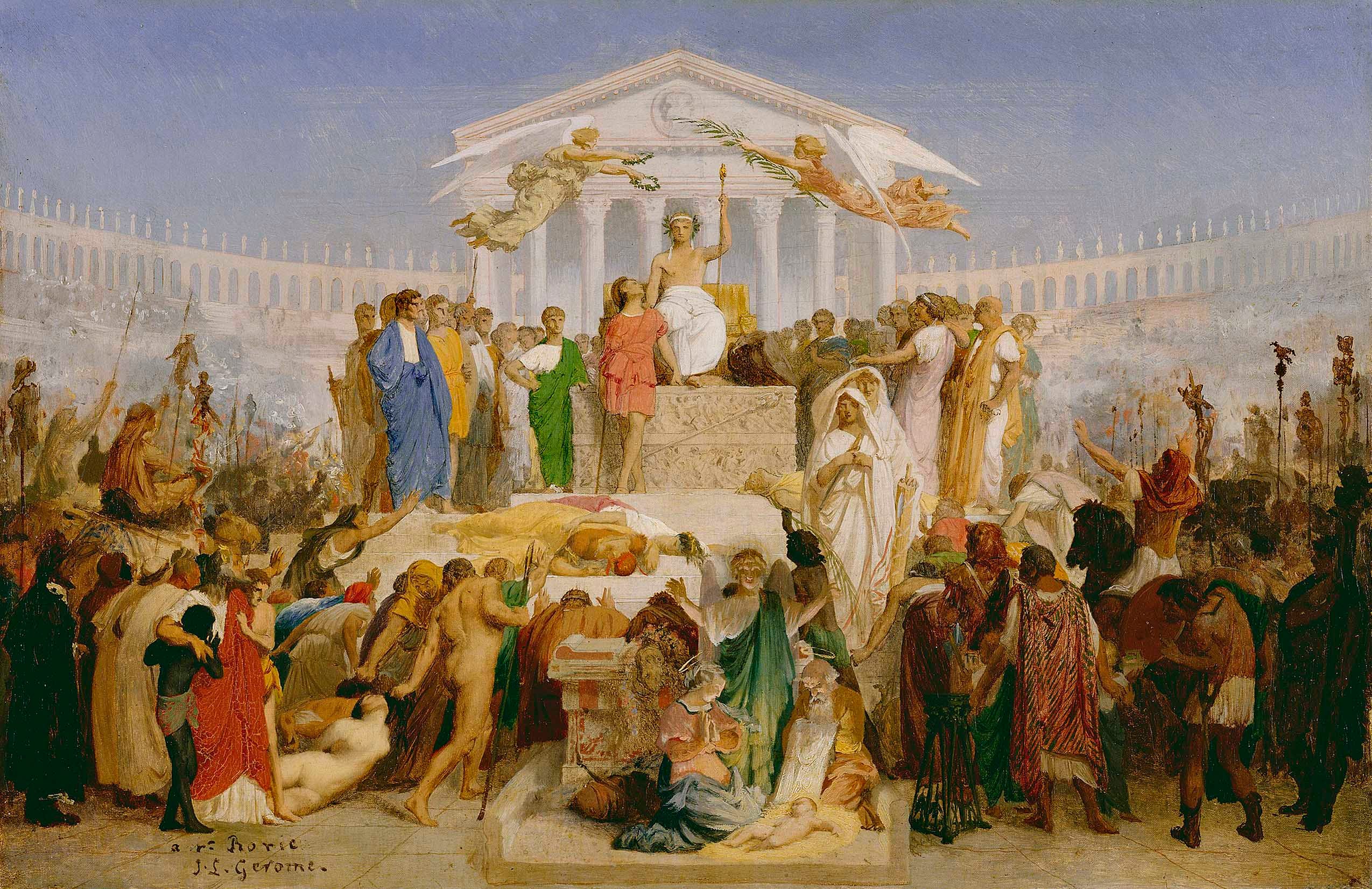
“Perform every action as though it were your last”. Or, on a more everyday note, when interacting with a person you otherwise do not know, especially those who you are unlikely to see again, ensure your conduct in that meeting aligns with how you wish them to remember you. If practised regularly, you will achieve that “godlike state” where all the good in your life matters, and all fault in it does not.
This sense of perspective is something you should consciously remind yourself of every day. No matter how gruelling the prospect of the day ahead seems:
“When you find an unwillingness to rise early in the morning, make this short speech to yourself: I am getting up now to do the business of a man”
Marcus Aurelius, Meditations, V.I
The business of a man is to grow, and do what he can to make the community and society around him grow too. Unless a person is directly preventing either of these things, they are not a truly negative presence in your life, and there is no reason to consider them as such. On the contrary, they are there to make you a better businessman.
Perhaps the most memorable line of Marcus Aurelius on perspective rather beautifully underscores Stoic philosophy on facing adversity:
“Nothing happens to anybody which he is not fitted by nature to bear”
Marcus Aurelius, Meditations, V.18
Such is the balance of the universe that all is relative. If an evil plagues many, then many are required to fight it. If an obstacle lies before you specifically, then it is not too big for you to breach alone. The Emperor is thus reminding us to be careful in the apportionment of blame. The system may well be against you in some fields. But in others, are you absolutely sure it is not your own inertia or pride that is obstructing you?
Now, your thoughts may well be drifting towards a certain elephant lurking in the room. This is all well and good if a person is simply combative or rude. But what if you are dealing with someone who is actively trying to undermine you? Someone who is not simply ‘having a bad moment’, but who is betraying you in the most heinous of ways?
Marcus Aurelius, who himself faced treason and rebellion during his reign, has a remarkably simple yet effective answer…
