
How a Young Man Falls From Grace
A Rake's Progress and the Danger of Temptation...

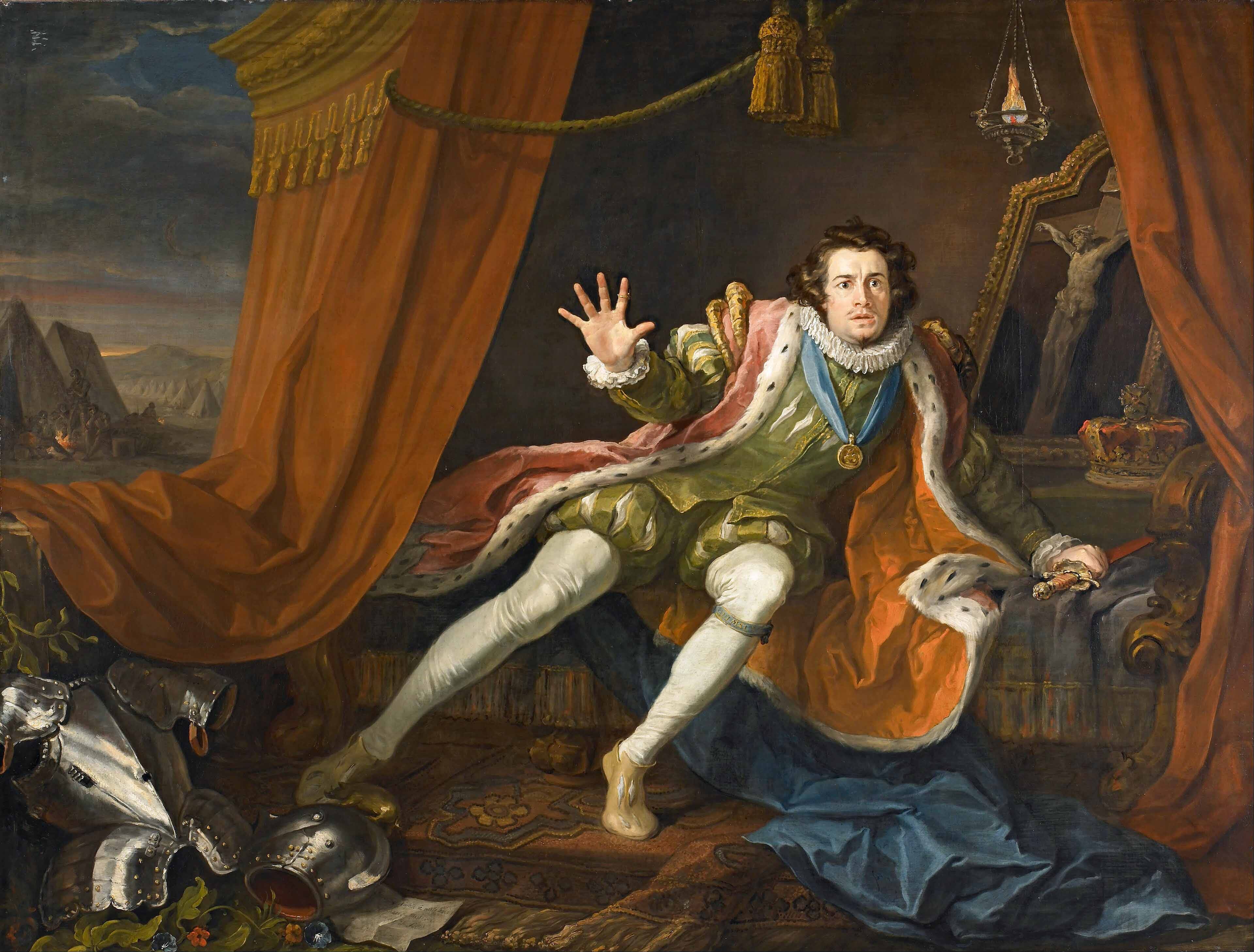
To be both young and virtuous is to navigate a dense minefield of temptation.
When we emerge from childhood and the household of our parents, almost everything appears possible. We are freed from restriction, and the future is ours to shape. But we are also freed from protection, and it is now up to us to judge what will be good for us, and what will be harmful. There will be inspiration, and so too temptation.
But temptation is a slippery slope, and all of us know at least one person who passed through school with great promise, only to go completely off the rails as an adult. Often, all it can take is one bad decision to spiral into ever worsening vices.
It is exactly this danger which forms the subject of William Hogarth’s A Rake’s Progress — a series of eight paintings which depict the tragedy of a young man who could have had it all, only to throw it all away. Enormously popular with the public of 18th century Britain, the series reached a vast audience when it was published as a bestselling set of engravings in 1735.
So in a special piece today, we explore what the eight iconic scenes of A Rake’s Progress can teach you about the temptations of youth, and how easily you can spiral into ruin if you do not take them seriously…
At INVICTUS, our mission is to explore the practical wisdom you can learn from the greatest leaders, thinkers, and artists of the past, through their own words and deeds.
If this resonates with you then subscribe below to receive an in-depth article every week exploring how influential figures were able to achieve what they did, and how you can start following in their footsteps…
I - The Young Heir
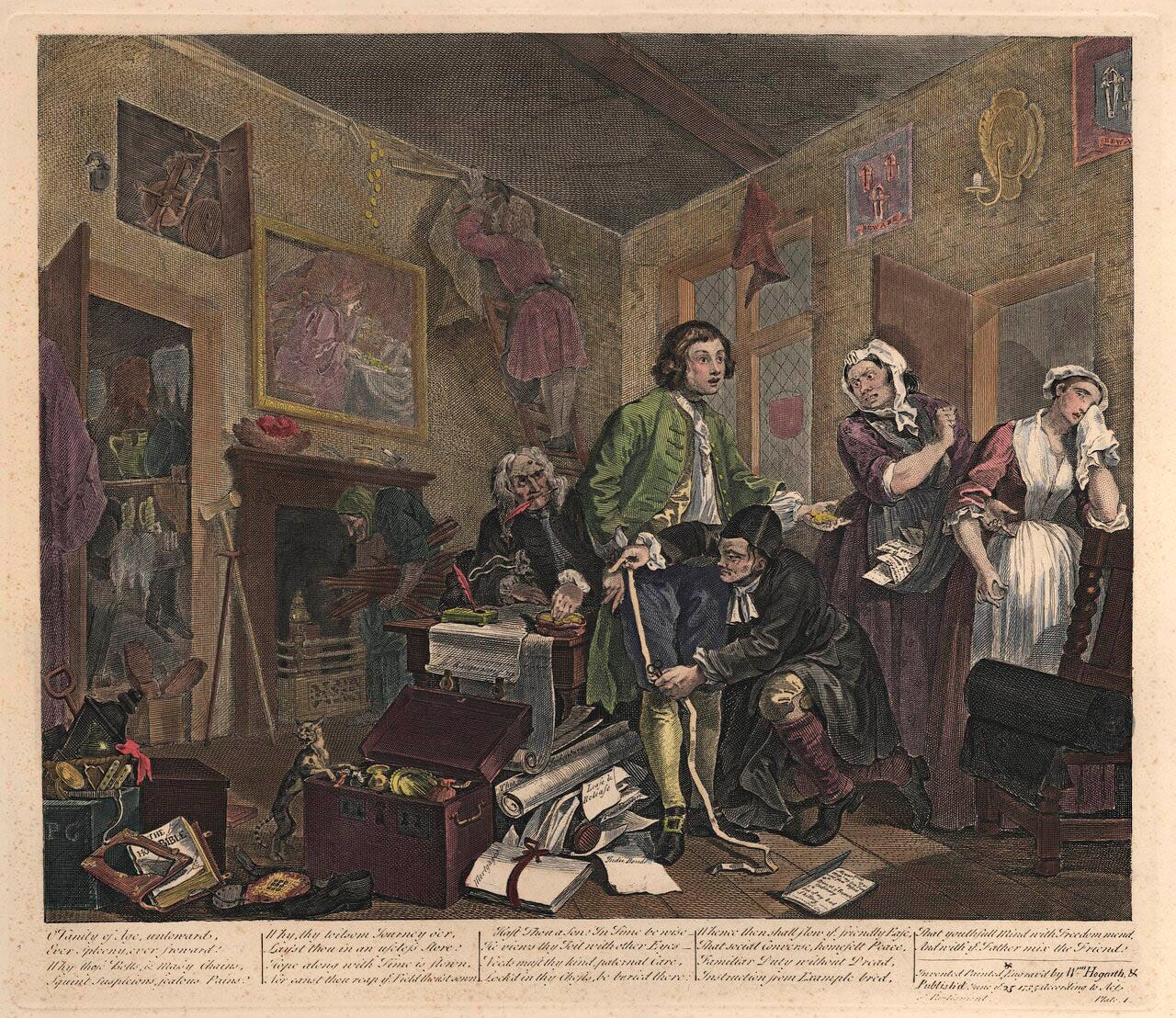
The first scene of A Rake’s Progress introduces us to the young man whose fall we are about to witness — Tom Rakewell — and his first stumble towards the slippery slope.
Tom is being fitted for mourning clothes in the wake of his father’s death. But hints abound that more is amiss. The family is wealthy, but as we can see from the man in the background attempting to shore up cracks in the ceiling, the house is in disrepair. The reason why however is indicated by the painting above the mantlepiece, showing a man counting coins. It is made more explicit by the man on the ladder accidentally dislodging a shower of gold coins that had been hidden in the cornice.
We understand that the father was a stingy man who devoted his life to accumulating money, but was terrified of losing it and loathed spending it — even on the essentials. The father’s meanness however has spilled over into his son, who has inherited the money but not the adequate education to receive it responsibly.
Overawed by his new riches, Tom breaks off his engagement to Sarah, the young lady on the right. Doubtless feeling he can now ‘do better than her’, he tries to pay off the distraught girl, whose arm falls to her side in despair, clasping her now voided wedding ring. As if to symbolise Tom’s transgression, letters are spilling from the apron of Sarah’s angry mother. His commitments now are worthless scraps of paper, joining the clutter on the floor. Though he does not know it, this terrible error will come back to haunt him.
Blinded by a stroke of ‘luck’, Tom has failed the first test. He has shown arrogance when humility was needed, and made the fatal mistake of assuming that present success renders him immune to future misfortune. His spiral has begun…
II - The Company We Seek
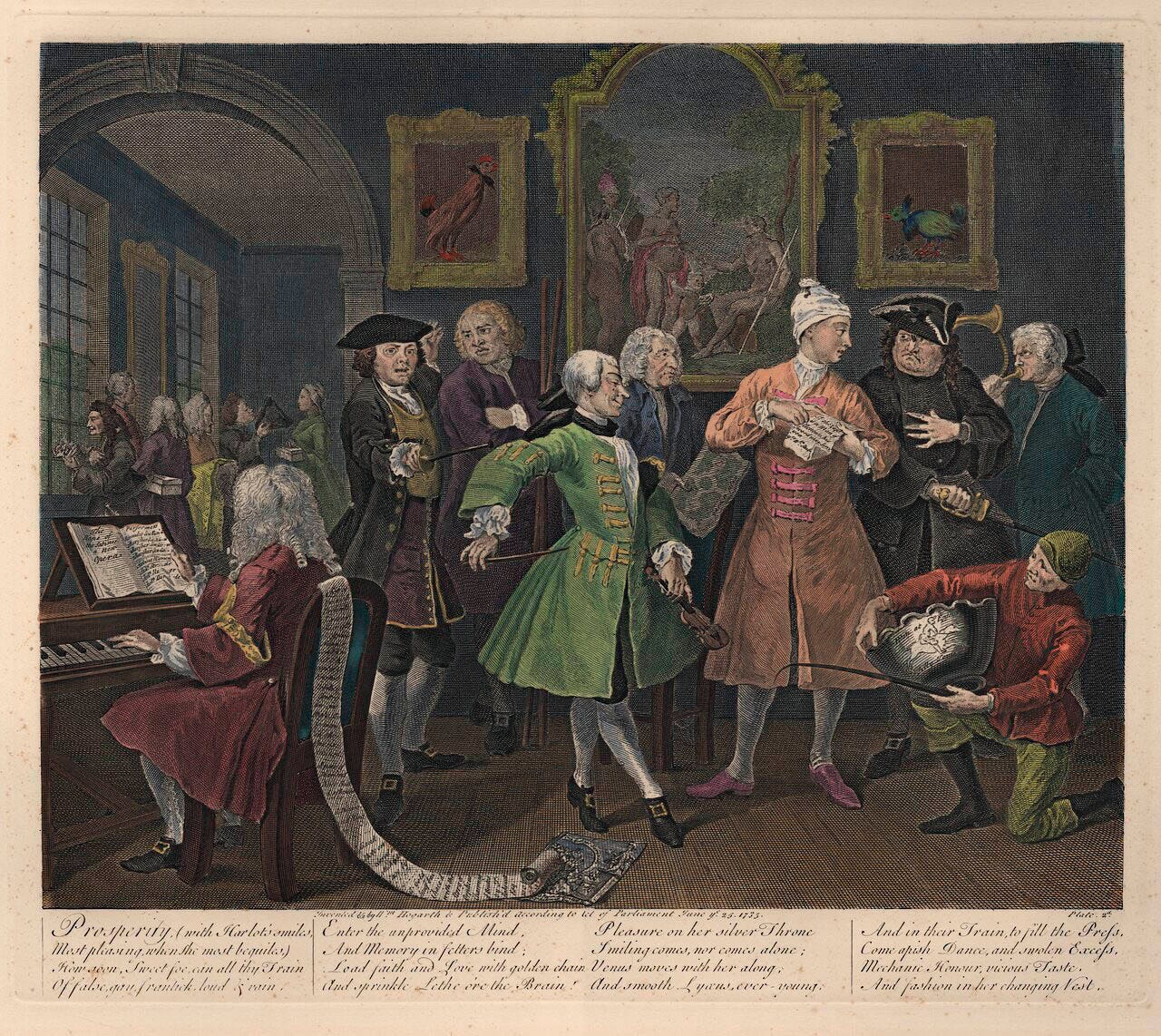
Relishing his new wealth, Tom gleefully enters high society. More interested in being seen with the ‘right people’ than cultivating his own inner worth, however, he (dressed in orange) begins to copy only the most superficial trappings of aristocracy.
Captivated by the fashion for foreign eccentricities, including the effeminate gait of a French dancer, he is vulnerable to those who have sinister intentions. Whereas a ‘legitimate’ fencing instructor can be seen on the left, Tom’s attention is captured by a roguish and overweight man on the right, who is dressed in black and grasping a sword. By the man’s somewhat thuggish expression, we see that Tom is already falling into bad company, meanwhile the most honourable men in the room, appalled at the degradation of the upper classes, stand behind, looking on disapprovingly and helplessly.
Tom’s money has bought him access, but it has not bought him discernment. He has misjudged which men will make him a better man, and is oblivious to how corrosive bad influences can be…
III - In the Tavern
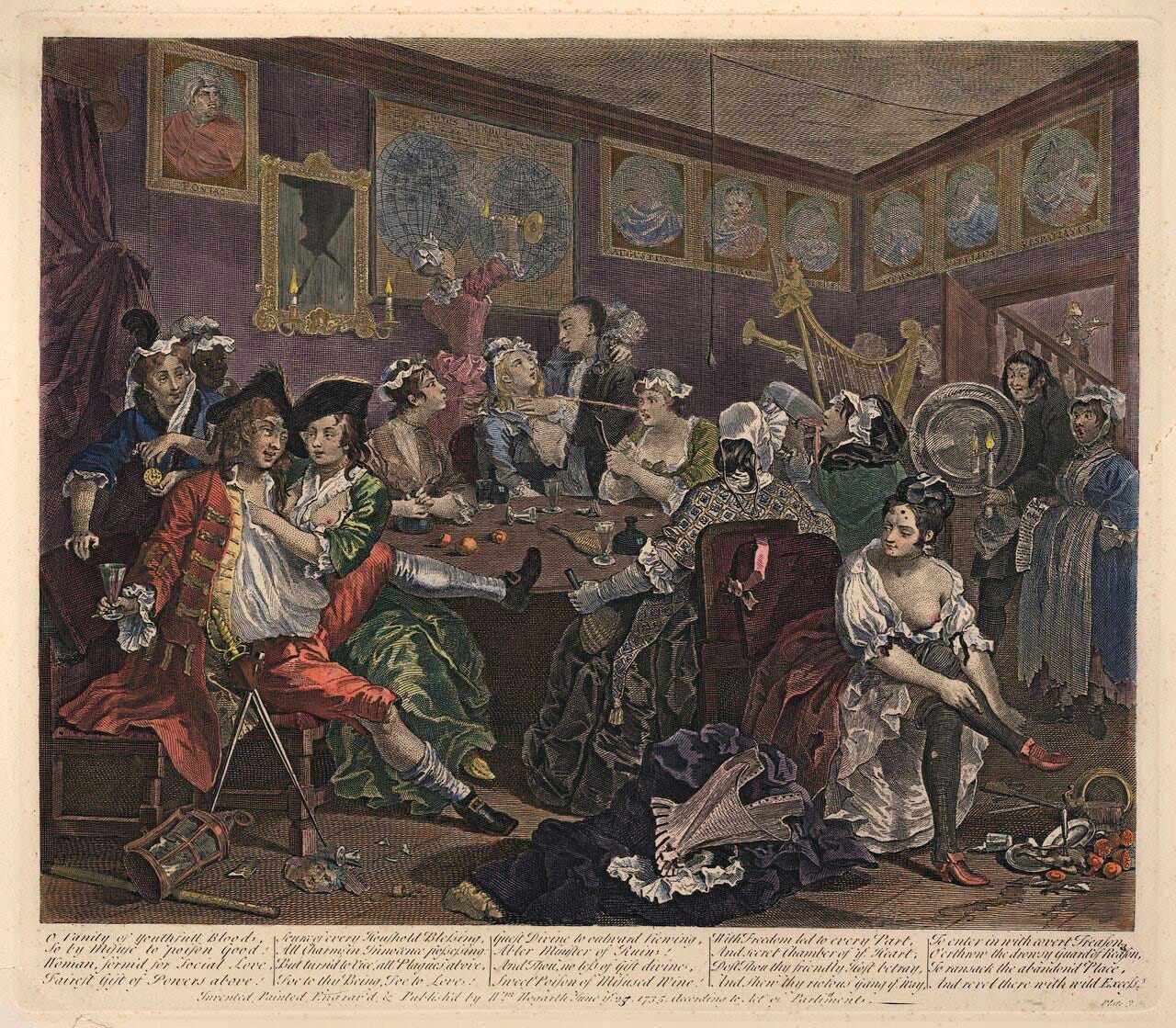
Tom’s acquaintance with questionable men has opened the door to questionable pastimes.
Doubtless encouraged by those questionable men, or else pushed by their peer pressure, he begins to waste his money and his body by indulging his base impulses. In a bawdy tavern, he is sweet-talked by attractive young women and distracted by their fawning attention. Conquered by his instinct, he is clueless as to the intention of the woman in front of him. Flattered by her apparent attraction, Tom does not notice that she has just picked his pocket, and is quietly handing his gold watch to an accomplice behind him.
Sliding into indulgence, Tom spends his father’s money on frivolous things, but the good men who could have given him the reality check he so sorely needs are not there. In his need to feel accepted by high society, he has consciously or not selected them out of his social circle, mistaking the loudest men in the room for the wisest. Tom is now truly a rake — a man who aspires to status but whose life perverts every ideal of nobility.
He either does not realise, or does not presently care, that all of the attention he is now receiving is false. It is his money, not his person, that is attracting them, and the moment this runs out, so too will their ‘affection’…
IV - The Arrest
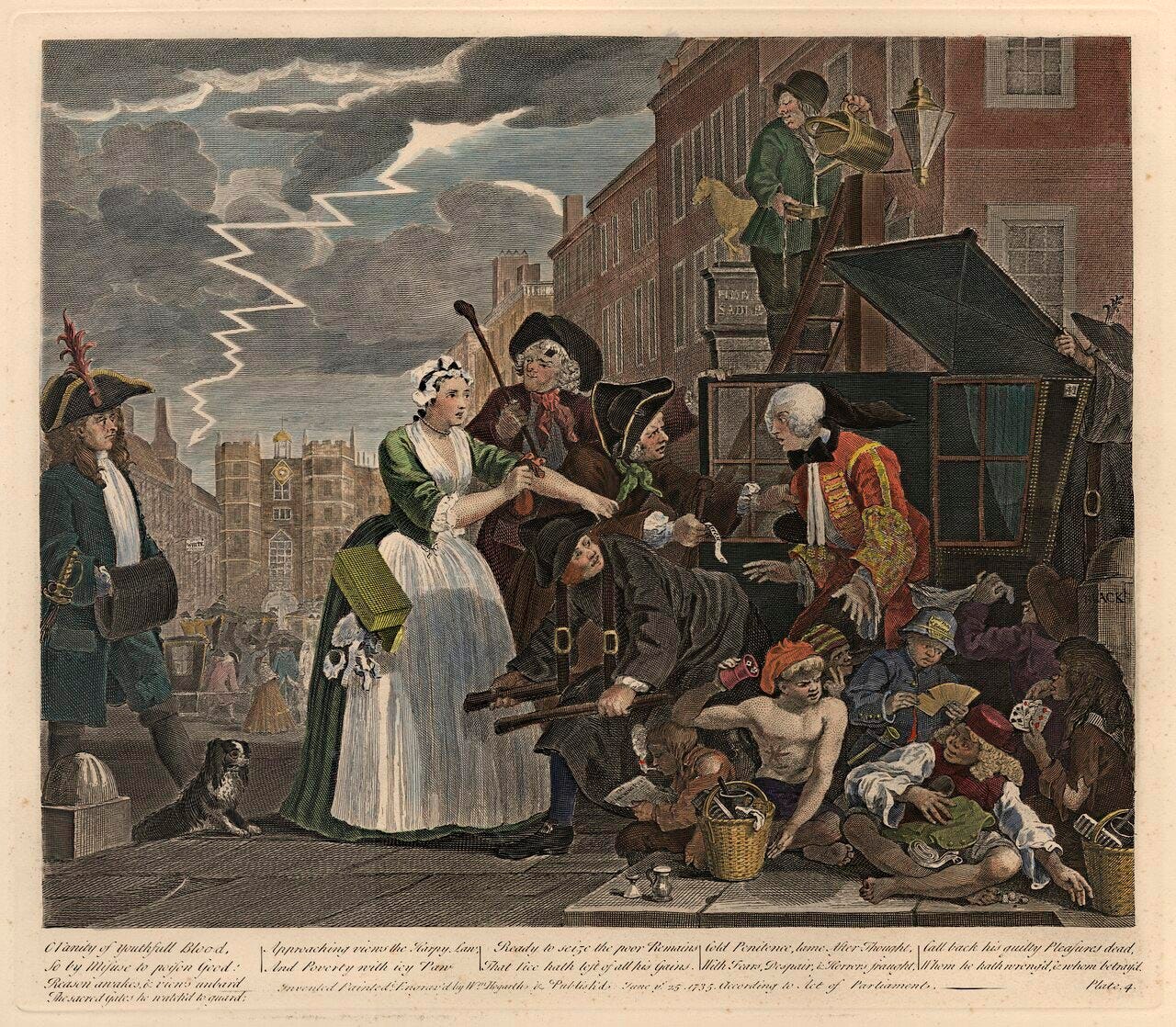
Here we see consequence beginning to catch up on young Tom. In his naive belief that carefree days would last forever, he has made no provision for the future, or misfortune.
Halted on the street, he opens the door of his litter to find the stern face of a bailiff, who brandishes a warrant for his arrest. Money, which was his sole blessing, has now become his curse. Debt has overturned his life, as Tom now discovers how quickly affection reveals itself to be false when money is involved. For Hogarth, whose own father had been condemned to a debtor’s jail, this moment surely struck close to home. As John Hoadly’s poetic caption beneath the image puts it:
“O vanity of youthful blood, so by misuse to poison Good! Reason awakes, and views unbar’d, the sacred gates he watch’d to guard; Approaching sees the harpy, Law, and Poverty, with icy paw…”
Yet even now, salvation calls out to our Rake. For a young lady dressed in green reaches out to stop the bailiff. It is Sarah, who he once proposed to and so cruelly cast aside. Out of charity and desperate hope, she moves to rescue the man she still loves from prison.
Now is the moment of redemption, or damnation. The Rake is at the crossroads of life that all of us reach when we realise the habits we have developed are harming us. Does he take the path of humility, and accept his mistakes, or does he take the path of pride, and insist his present plight is all just bad luck?
His choice will decide, and define, his life…
V - The Lost Chance
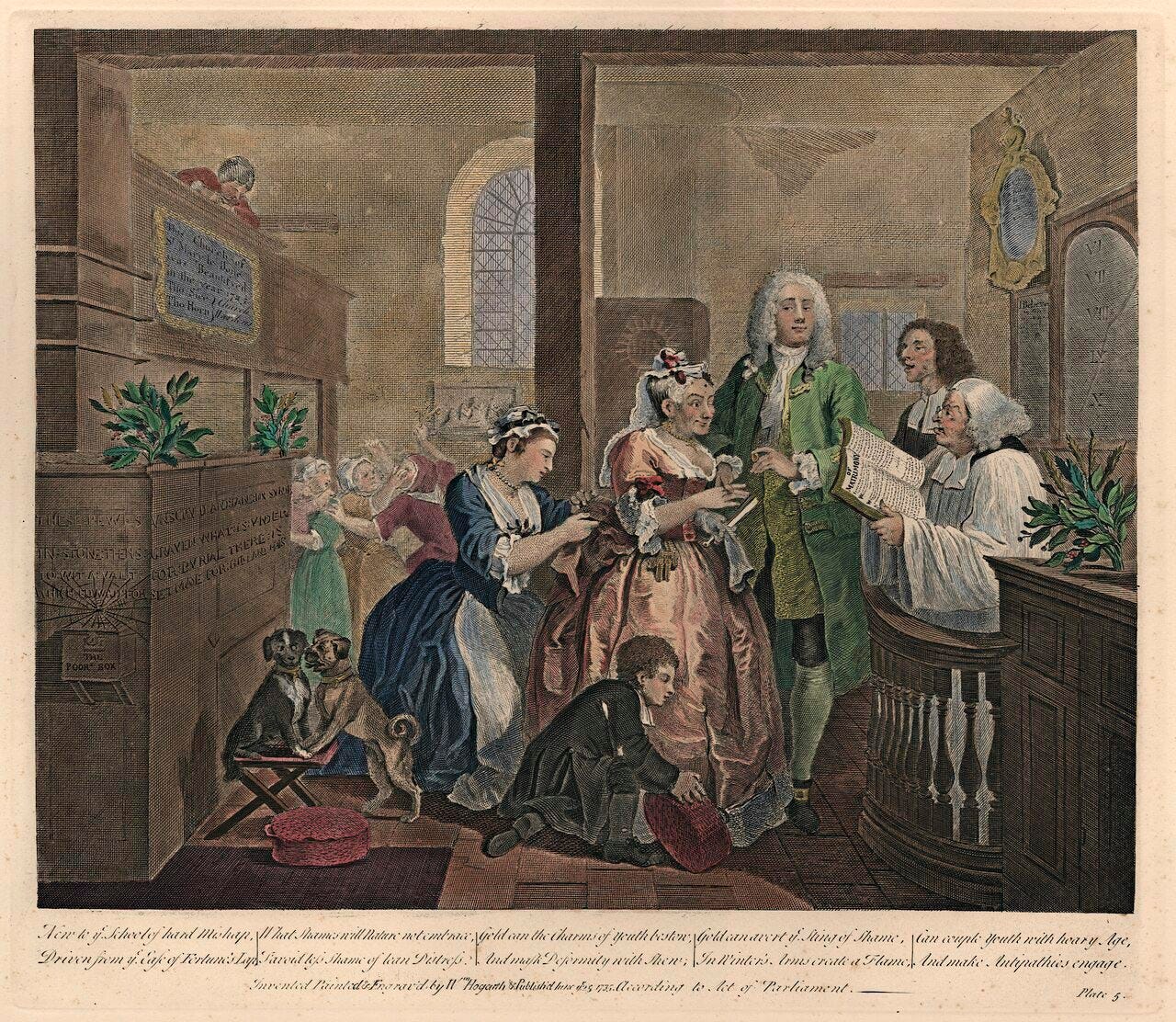
Unfortunately for Tom and all those around him, he chooses poorly.
By now dependent upon the lifestyle of luxury to which he has tied his inner worth, his spiral into sin veers into personal humiliation. Scorning the lady who could truly turn him to the light, he instead marries a wealthy one-eyed woman, bent with age, so that she may bail him out. As the caption declares:
“New to the school of hard Mishap, driv’n from the ease of Fortune’s lap, what shames will Nature not embrace t’avoid less shame of drear distress!”
The ceremony is conducted in the recognisable ambience of Saint Marylebone Church, a venue notorious for discreet weddings that would cause social embarrassment elsewhere. In a further sign of this folly, Tom’s eyes drift over the head of his new spouse, and appear to linger upon the youthful maid. It is a mockery of marriage and the vow he is nonchalantly swearing, and it is already doomed.
Compounding the tragedy, a scuffle in the background reveals that Sarah is fighting desperately to halt this unseemly fall.
But the window is closing, and Tom has chosen ignominy in exchange for hope. Unfortunately for him, this ignominy will long outlive that hope…
VI - The Price of Vice
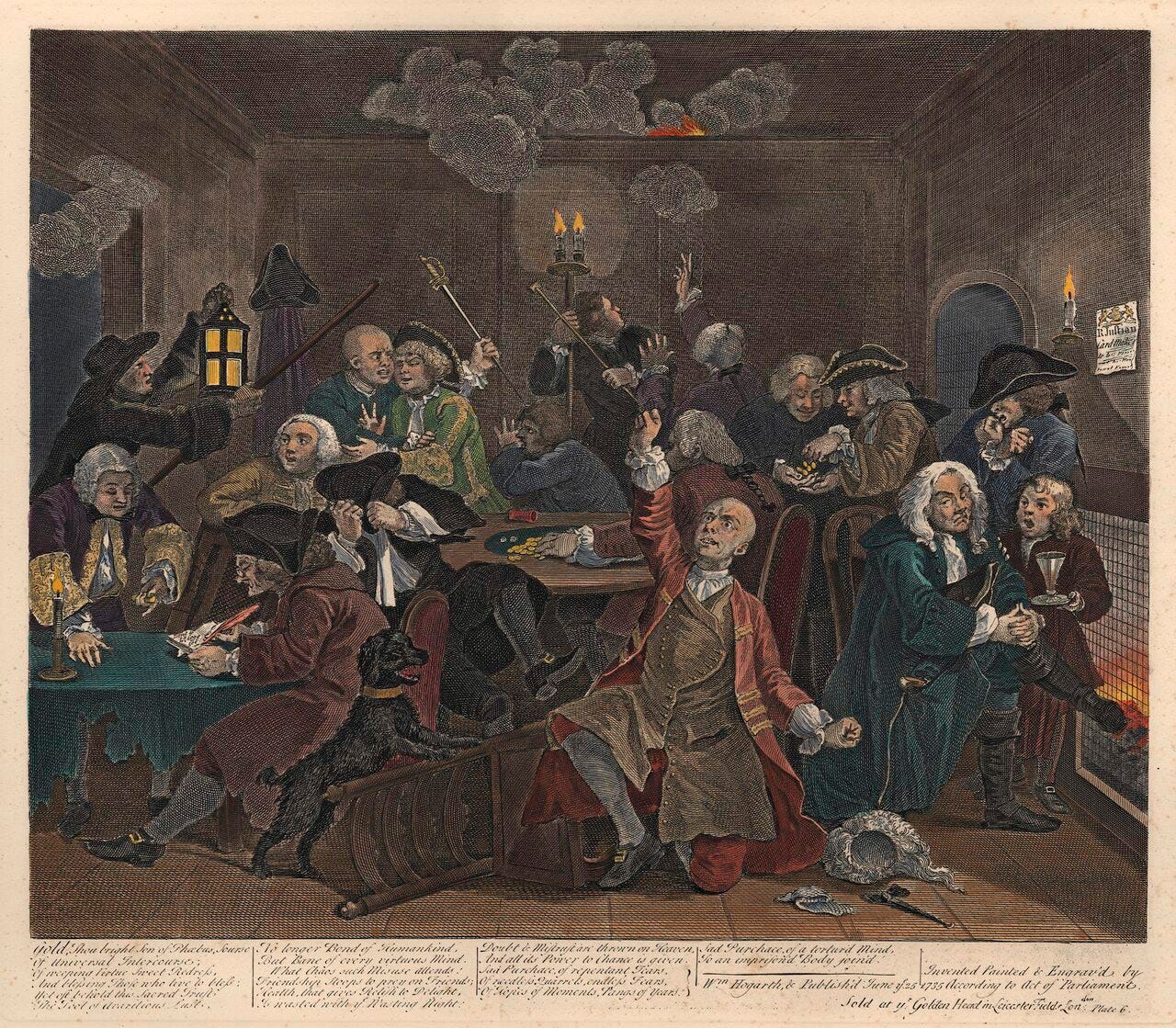
Our Rake has money again, but the price of gaining it was far higher than its worth.
Since his new wife was a means to an end, he derives no joy from her company, and builds nothing with her. Having acquired a fortune twice now without investing a proportionate amount of his own labour or talent, he has learned nothing. On the contrary, his prolonged exposure to pleasure, and his habituation to indulging it on demand has desensitised him to stimuli and scandal alike. What even he would once have been ashamed to let others see now plays out in the open.
Barely recognisable now, Tom is upon one knee, fists clenched and eyes wide opened as if seized by madness. On the gambling table behind, fortunes built over generations are lost in a single game of dice. Greed, rage, elation and banal indifference surround him, as ‘friend’ preys upon friend, but he no longer hears or sees. His sole companion now is a baying dog.
Yet we can see a fire catching on the distant wall. The body and soul have limits before both are consumed, and judgement is coming…
VII - The Reckoning
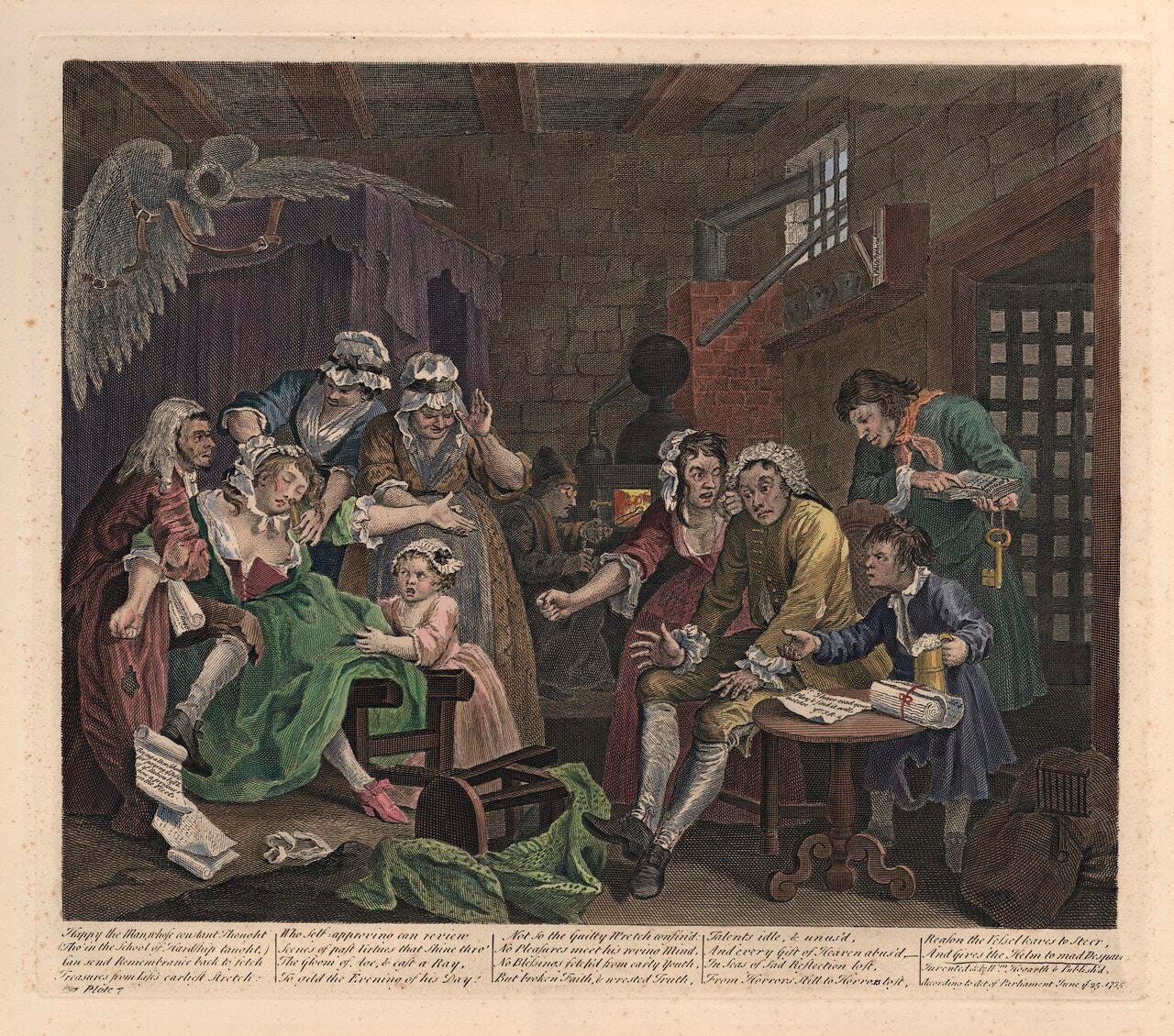
Following the very definition of a madman, Tom thought the same path would not result in the same end.
His second chance now utterly squandered, debt has once again swallowed him, only now he has dragged another down with him. His loveless marriage is now aflame, as the deceived wife (clothed in red), thinned by stress and the financial hardship into which her husband has cast them, berates a dejected Tom (in yellow).
Realising far too late that only a productive life is worth living, he has written what he hopes will be the work that earns him fortune and glory once more. But the courier boy has brought him the publisher’s rejection. His last gamble has failed, and there will be no third chance.
Before him, clad in green and fainting from distress, is the girl who could have spared him all of this, and given him a dignified married life. Yet Sarah’s hopes break as she cannot save him from the debtor’s jail this time. The hour of Tom’s reckoning has come, for a man may only debauch himself for so long before a debt of a different kind is called in…
VIII - The Judgement
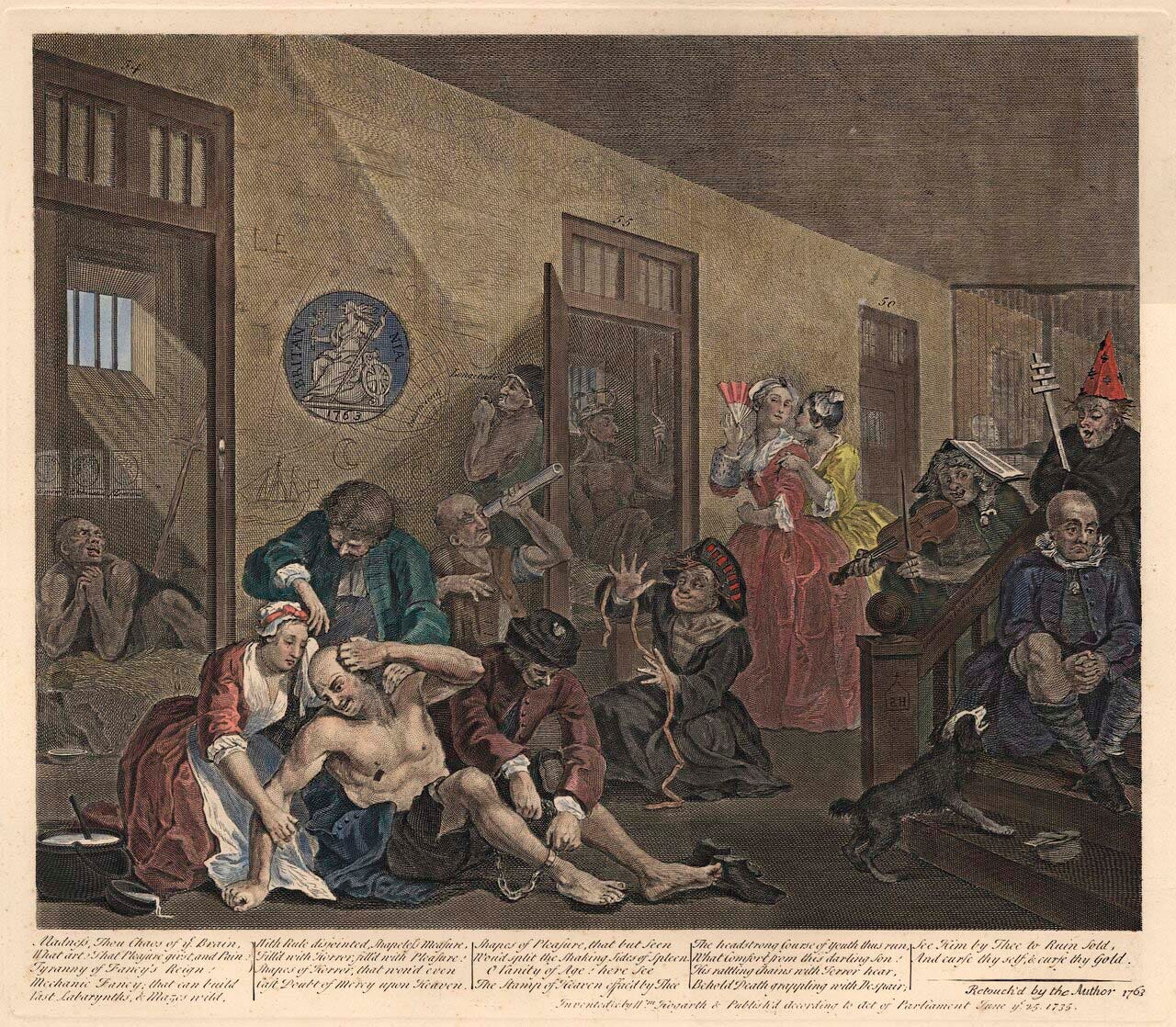
Driven insane by the consequences of his poor choices, and no longer able to distinguish between the fantasies of his mind and the reality that lives beyond, Tom is committed to the infamous Bedlam Asylum.
Ravaged by guilt, regret and anguish, where once the Rake had delighted in the company of high society, he now knows only the screams of lunatics and mutterings of outcasts. As if to complete his humiliation, unbeknownst to him two aristocratic ladies in the corridor are observing him as if he were a wild beast in a zoo. He desired the attention of the powerful, and now he has it.
Yet even here, divine mercy can never entirely abandon a man. For now at the end, despite all she has endured because of him, Sarah holds Tom in a caring embrace, her heart broken for him.
The Rake craved admiration, and turned to debauchery. Tom could have had it all, and now has nothing but the pity of others, and all that keeps him alive is a goodwill he never earned and is now incapable of recognising…
The Rake’s Redemption
A Rake’s Progress proved so popular that modern copyright law on visual media was a direct consequence of it. It was indeed in response to the sudden spread of cheap imitations of Hogarth’s works that the Engraver’s Copyright Act was passed in 1735, granting British artists the same protections as authors.
But the series struck such a chord in Britain because the country was awash with suspicion that decadence was taking hold in her increasingly mercantile elite. Two generations on from the ‘Glorious Revolution’, traditional aristocracy was beginning to visibly give way to a new tycoon class, one which would indeed go on to dominate the Victorian empire of the 19th century and beyond. With so many families coming into wealth, at a time when London was steadily transforming into the counting house for much of global trade, a growing number of them would witness their sons succumb to their very own ‘Rake’s Progress’.
Yet the heartening element which Hogarth carefully included in the series is that such a decline need not be inevitable. The character of Sarah, after all, is present in each scene that Tom has not intentionally excluded her from. She serves as a continual reminder both of how his spiral began in the first place, and that we should never succumb to the sunk cost fallacy and convince ourselves that we are in too deep to escape.
Indeed, A Rake’s Progress reminds us that if we feel any doubts over the direction our life is taking — be it in the habits we have fallen into or the company we are keeping — then the unease and guilt we feel is actually a good sign.
It is our soul indicating to us that the window of redemption is still wide open. Others might be telling you it is raining outside when it is actually shining, but the decision to close it is only ever yours…
Thus strikes me as the mirror image ot The Pilgrim's Progress. Did Hogarth have that in mind?
Thank you for taking the time to reveal and discuss this work of art with timeless wisdom. Imagine these paintings as posters in the middle and high school hallways!