
Are You In The Meat Stall?
The 16th century's hidden guide to virtue...

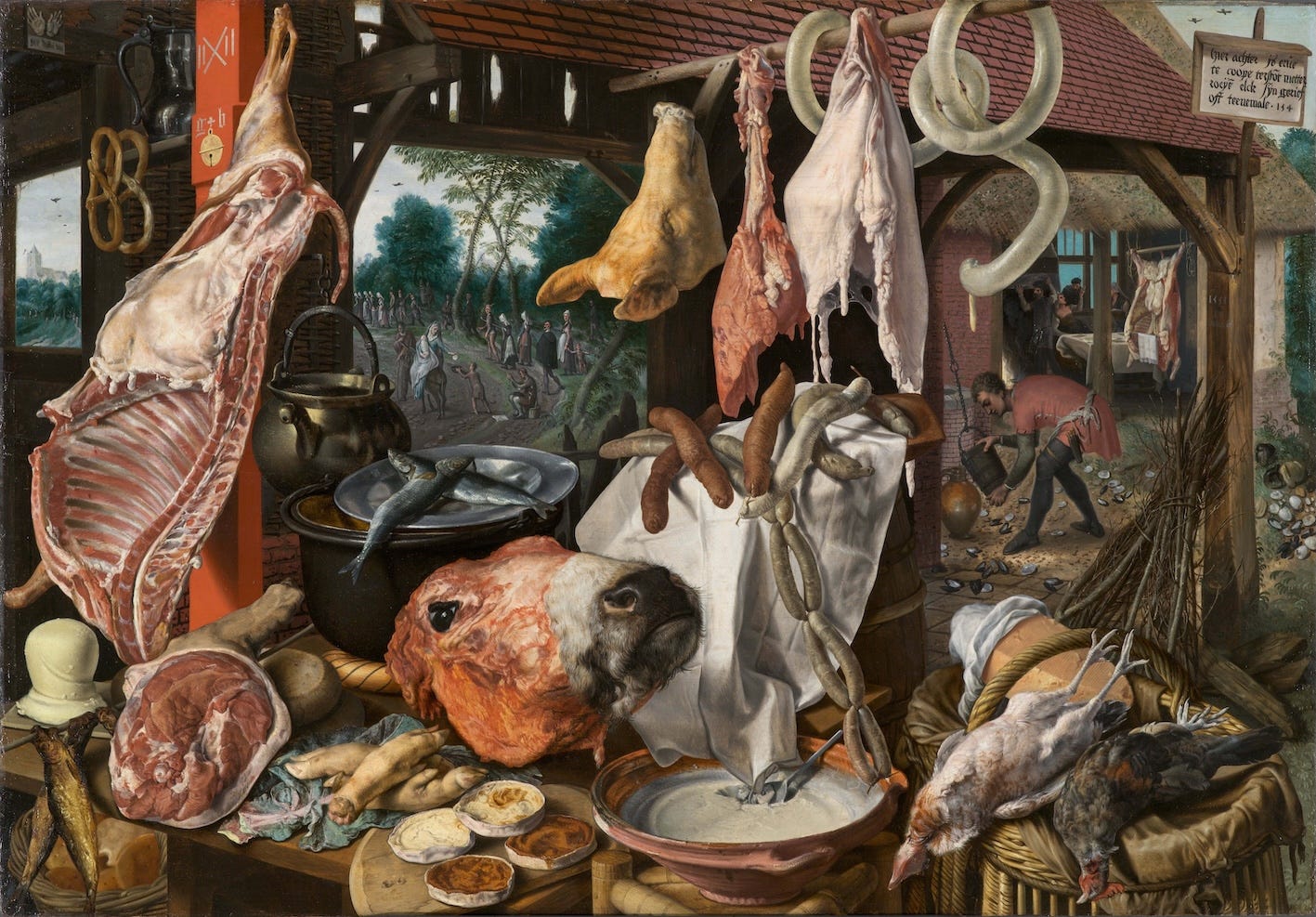
At first glance, the above painting looks like any other still-life. Technically brilliant, but without anything ‘to say’. But if you stopped at that first glance, then it is you who this painting is satirising.
A Meat Stall with the Holy Family Giving Alms, after all, is far more that what it appears. Look beyond the butcher’s stall, and details suddenly emerge everywhere. Not only details either, but symbols, all of which reveal timeless advice for leading a righteous life — and powerful warnings of the consequences of straying.
The painting is also a coded traditionalist attack on modernity. As a Dutch Catholic caught up in the turmoil of the Reformation, artist Pieter Aertsen was risking the censorship of Protestant authorities to denounce the increasingly materialistic and ruthless business leaders of the city of Antwerp.
So in a special piece today we explore why you must beware the Meat Stall, and how this enigmatic masterpiece of 1551 can teach you to distinguish between what you want and what you need…
The Meaning of the Meat
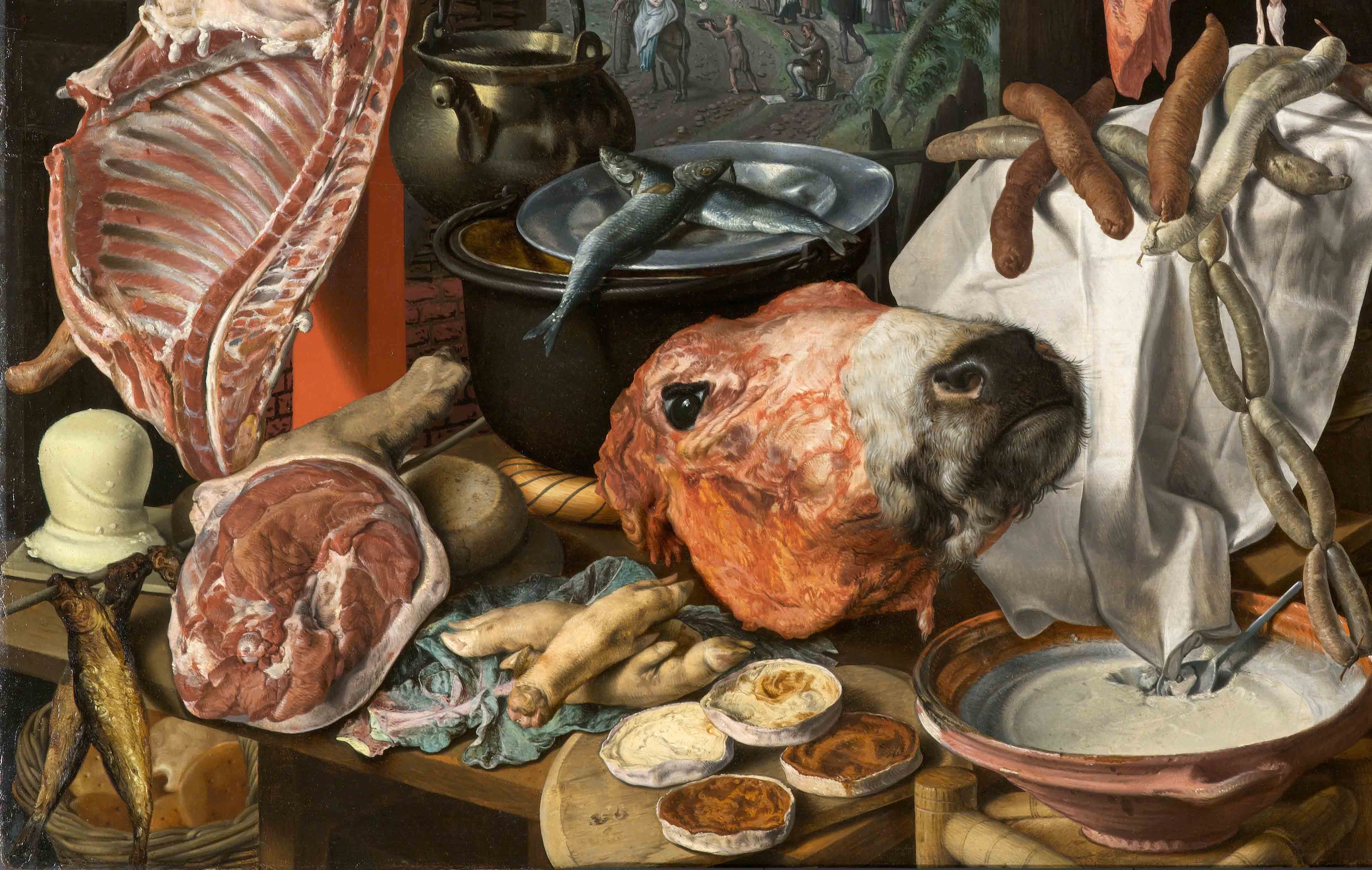
As you had doubtless already noticed, the majority of the canvas is dominated by the butcher’s stall and its sumptuous goods. It is a near irresistible display of meat, dairy, poultry and fish. It is also a training exercise for the viewer.
When the overwhelming initial effect subsides, certain details may begin to intrigue or disturb you. Amongst all of the expertly depicted cuts, what almost certainly caught your eye first was the severed ox head just off centre.
While we are often tempted to read human emotions into animals where they may not be present in real life, the ox head here is fixing us with an undeniably baleful glare. The closer you look at the pupil, the more unsettling it becomes. Something dire has happened, or is happening, here and we face the choice to ignore it and walk on, or look around us, and act upon it. Just what it is that is so terrible however reveals itself to us first with subtlety, and then with a clamour.
At first perhaps, that ox’s stare pierces our wonder at the butcher’s rich goods with an inexplicable guilt. The sausages do not elicit sympathy, but the ox dares to remind us that violent death brought us this scene. Aertsen, however, is not telling us to be vegetarian. What he is telling us is indicated by something else which is off here. Why would a butcher display bloody cuts of meat on or over a pristine and easily-stained white cloth?
He of course would not, unless he wished to highlight the messiness of his craft. During Holy Communion however, a Catholic priest wraps the chalice of the Eucharist in a very similarly sized piece of white linen, in reverence for the sanctity of the body of Christ. Just as the ox suffered and died for our sustenance, so too did the Son of God for the souls of all men, and it is that greater sacrifice we forget at our peril. This, then, is the true meaning of ‘the Meat’ — it represents every distraction, great or small, which turns us away from what matters most in life.
You may be thinking that this is too subtle. However, as mentioned above, the messaging of this painting is told in a crescendo, for the Meat is not merely the foreground. It is also a frame.
The indulgence on display almost drowns out the true subject of the painting, but if you look directly above the ox head, you will see two fish on a silver dish. Two fish laid in the shape of the Cross, yet also of an arrow, guiding us to what lies beyond the ‘Meat Stall’ of life…
The Meat of the Soul
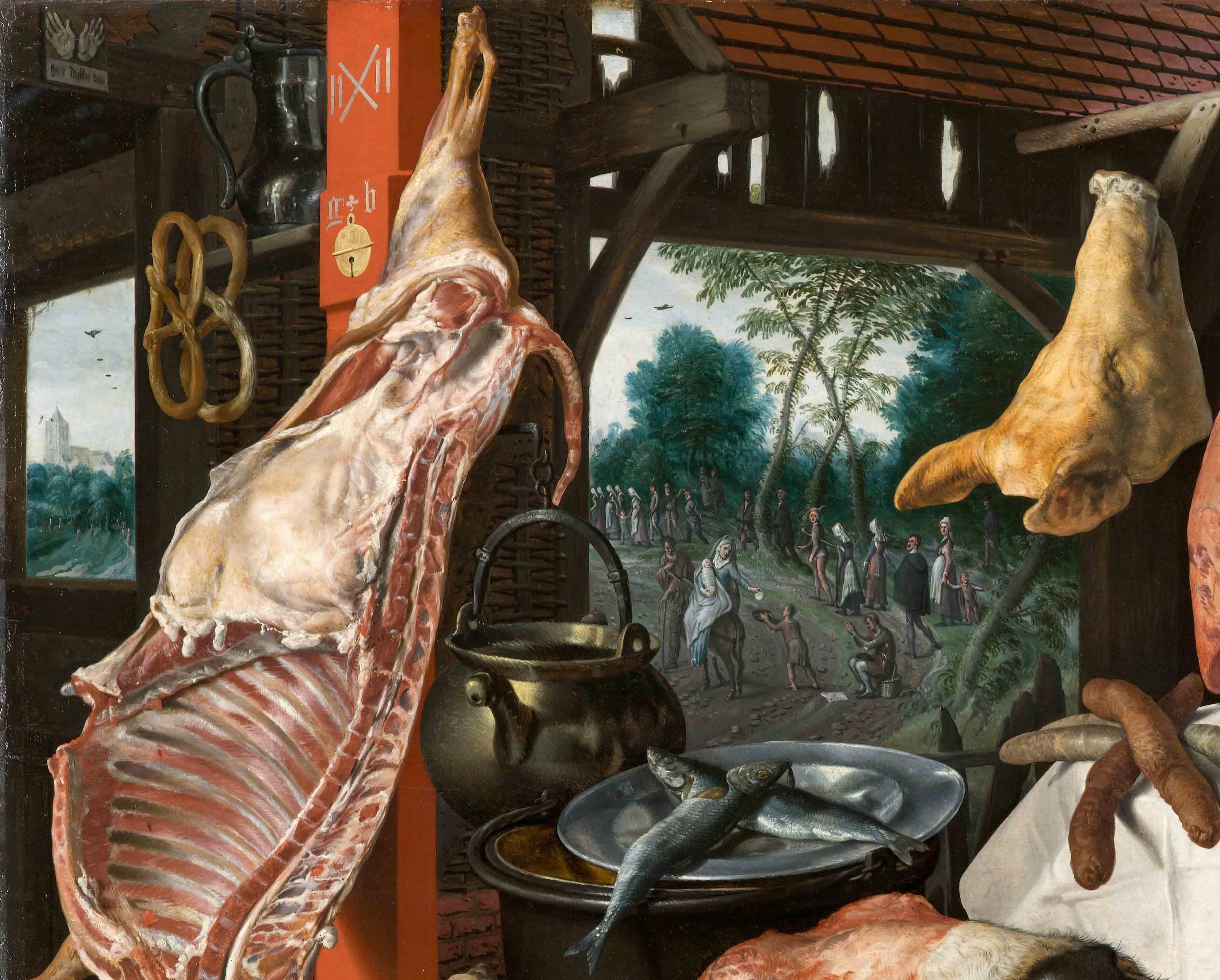
If you have followed the crossed fish, then you have crossed the first hurdle, and are bridging the earthly and spiritual worlds. From the ox’s head, the fish lead us to the Holy Family itself.
The setting is not glamorous. The ground appears muddy, the sky overcast, and the scene ‘desaturated’ compared to the colourful meat. The Virgin Mary is carrying the infant Christ with one hand, and with the other, she is reaching down from horseback to give a child a loaf of bread. But the goodwill exists on both sides. An adult is seated on a basket directly behind the child, with a piece of paper between them in the dirt. It is likely the child’s father, too infirm, malnourished or possibly proud to rise. The poor family, and the Holy Family, are joined through the humility of the child and the charity of the Virgin.
Suddenly, the foreground takes on a new meaning. After all, for those who did not rear their own livestock meat was considerably more expensive in the 16th century compared to today. The Meat therefore is also representing costly luxury, and the almost wasteful abundance of it is suddenly rendered rather vulgar. Said meat will decay if left out, and will soon be forgotten if consumed. Even if ‘used’ properly, it represents consumption over investment. How much, indeed, of what you are either chasing or building will be admired by your descendants, or carried over to the hereafter?
At the same time however, Aertsen is reminding us that ‘doing the right thing’ does not need to be ‘expensive’. Simply helping somebody in need, or even just lending somebody your attention could change a life. It is a vice to remain in the Meat Stall, and consider generosity as something that can wait until you have ‘made it’ in life.
As if to highlight this, directly behind the Holy Family we can see a line of ordinary people growing. The pillar of the butcher’s shop figuratively and literally interrupts the view, but the perspective of the background makes it clear that the crowd is heading to the church on the far left of the painting. That is no random ‘church’ however. It is recognisably Antwerp Cathedral, and directly above it, we see the twin white hands which still today adorn the city’s coat of arms.
Just as the Holy Family directs the people of Antwerp towards the Cathedral however, the perspective line of the Meat is working to lead our eye away from it. Yet between the Cathedral and the butchered pig hang two pretzels and a jug which would typically hold wine. Aertsen’s sign, perhaps, that the bread and the wine — or the body and blood of Christ — can break our slide into temptation and put us back on the road to salvation.
Yet Pieter Aertsen knew that men cannot simply be told what will happen if we do not leave the Meat Stall. They have to see it for themselves. For the same reason, he did not specifically depict Antwerp Cathedral for tourist appeal or mere lack of imagination.
This entire painting, indeed, is grounded in a very real warning from history, and the true reason for the ox’s tortured gaze…
